The name of this compound is quite difficult to pronounce, Polychlorinated Biphenyls. Also, it is not something that is generally known and discussed by the general public. Among academics, practitioners and policy makers who are familiar with this compound, the pronunciation is preferred to be shortened, namely PCBs or PCBs (plural). Therefore, it is often mixed with Printed Circuit Board which is also abbreviated as PCB. What exactly are these Polychlorinated Biphenyls compounds?
PHYSICAL AND CHEMICAL CHARACTERISTICS OF PCBs
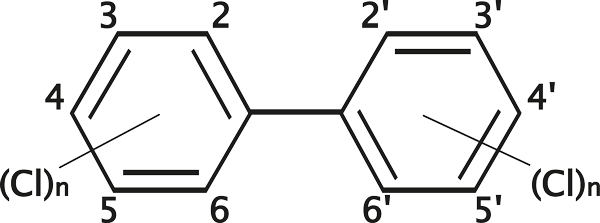
Polychlorinated Biphenyls (hereinafter abbreviated as PCBs in this paper) are aromatic compounds (that is, hydrocarbon compounds with a cyclic or ring-shaped structure) that do not occur naturally in the environment (nature). Chemically, PCBs consist of a biphenyl or biphenyl group (two benzene bonds) bonded to 10 chlorine or cl- atoms. The chemical formula of this compound is C12H10-nCln, with the number of n ranging from one (1) to 10. Theoretically, the chemical formula allows the formation of 203 derivatives of PCBs or commonly referred to as congeners. However, only 130 congeners have been identified in commercial products. PCBs that are traded commercially are in the form of clear to pale yellow oil, or in the form of resin, and do not undergo crystallization even at low temperatures (WHO, 2000).
PCBs are artificial (synthetic) compounds produced by adding or reacting (addition reactions) chlorine atoms with biphenyl groups until the expected percentage of chlorine is reached (EPA, 2021). Compound PCBs were created with one goal in mind, namely to obtain compounds that have a high flash point. Flash point is the temperature or temperature at which the compound will evaporate and cause a fire (burn) when exposed to sparks. The flash point of PCBs compound ranges from 170o – 380o Celsius. The higher the percentage of chlorine added to the biphenyl group, the higher the flash point. Because of their high flash point, PCBs are said to be fire resistant compounds. PCBs also have low electrical conductivity, high thermal conductivity, and are highly resistant to thermal degradation (WHO, 2000).
HISTORY OF PRODUCTION AND USE
PCBs-like compounds (“PCB-like”) were first discovered in 1865 in coal tar, which is a black, concentrated liquid byproduct of coal production. More than ten years later in 1876 a German chemist, Oscar Döbner, succeeded in "refining" these PCB-like compounds into Polychlorinated Biphenyls. However, the commercial and massive production of PCBs only started in 1929 in the United States, which was pioneered by the Swann Chemical Company in the city of Anniston.
The commercial production of PCBs is closely related to the physico-chemical characteristics of these compounds, namely high flash point, low electrical conductivity, high thermal conductivity, and are stable or not easy to react with other compounds or undergo degradation. With these characteristics, PCBs become premium oils that are added/mixed to various products to increase the durability, performance or service life of these products, whether in open or closed applications. Some examples of use in open applications are oil paints, sealants and carbon copy paper. The use in closed applications is in electrical equipment, such as sockets, fluorescent lamp ballasts, bushings and other equipment that is susceptible to heat. The largest use of PCBs (more than 60%) is as an additive to dielectric oils in electrical transformers and capacitors (UNEP, 2002).
By adding PCBs to the dielectric oil, the risk of fire in the transformer and its associated effects can be reduced or even eliminated. For more than 40 years the use of PCBs dielectric oil has become a prerequisite for safety standards in buildings and buildings that have high risk where the risk of fire and explosion is a major concern (Monsanto, nd). Therefore, it is not surprising that at that time transformers and capacitors produced using PCBs were used in public facilities such as schools and hospitals as well as industrial sites that required optimal protection from the risk of equipment fires, for example in underground mines, railroad systems. and military installations (Basel Convention, 2021). The following are some of the transformer brands that have been manufactured using PCBs.

However, it cannot be generalized that all transformers made by the above companies contain PCBs. Years of use of PCBs in the transformer brands above are certainly closely related to the period of production and circulation of PCBs in the world. PCB Elimination Network (PEN, 2016) notes that PCBs were produced by at least 13 companies worldwide from 1930 to 1993 with a total world production of more than 1.3 million tons under various names/trademarks.

PEN confirmed the first production of PCBs in the United States in 1930 (some sources state 1929) with a total production of 700,000 tonnes. This number is the largest, produced up to 1977 (including those produced by Monsanto UK). The most recent production year on record was that of the Soviet Union in 1993. The Soviet Union produced more than 170,000 tons since 1939. Detailed information on the proudusen name, country of origin, period and number of PCBs production can be seen in the table below.
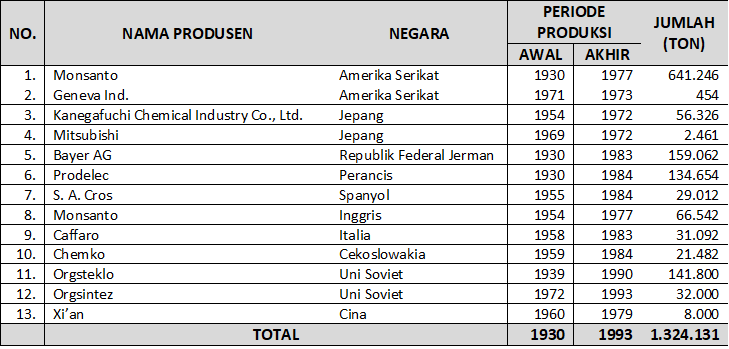
By comparing the two tables above, more serious attention needs to be paid to the transformers produced by the companies listed in Table 1, especially those produced in the period listed in Table 2.
However, it is very necessary to pay attention to regulations related to the prohibition of PCBs in each country. In the United States, for example, although Monsanto had stopped producing PCBs in 1977 (Monsanto, nd), the ban on the production and use of PCBs in that country was only implemented two years later, in 1979 (EPA, 2021).
If you need Laboratory Testing of PCBs Content in Transformer Oil according to IEC 61619, please click: here.
REFERENCE
Environmental Protection Agency. 2021. https://www.epa.gov/pcbs/learn-about-polychlorinated-biphenyls-pcbs
Japan Offspring Fund. 2003. What are PCBs? http://tabemono.info/report/former/pcd/2/2_2/e_1.html
Basel Convention. 2021. Updated Technical Guidelines for the Environmentally Sound Management of Wastes Consisting of, containing contaminated with Polychlorinated Biphenyls (PCBs), Polychlorinated Terphenyls (PCTs) or Polybrominated Biphenyls (PBBs).
http://www.basel.int/Portals/4/Basel%20Convention/docs/pub/techguid/tg-PCBs.pdf
Monsanto. nd.
https://www.toxicdocs.org/d/KRGjYJ9QzJyw90Z38enjNMBvX?lightbox=1
PCB Elimination Network. 2016. Polychlorinated Biphenyls (PCB) Inventory Guidance. PCB Elimination Network (PEN). https://wedocs.unep.org/bitstream/handle/20.500.11822/31250/PCBIG.pdf?sequence=1&isAllowed=y
United Nations Environmental Programme. 2002. PCB Transformers and Capacitors from Management to Reclassification and Disposal. Inter-Organization Program for the Sound Management of Chemicals. http://chm.pops.int/Portals/0/download.aspx?d=UNEP-POPS-PCB-GUID-TRANSCAP.English.pdf
United Nations Environment Programme. 1999. Guidelines for the Identification of PBCs and Materials Containing PCBs. Inter-Organization Program for the Sound Management of Chemicals. https://www.aber.ac.uk/en/media/departmental/healthsafetyenvironment/pcb_unep1.pdf
World Health Organization. 2000. Air quality guidelines for Europe: second edition. World Health Organization Regional Office for Europe. https://apps.who.int/iris/handle/10665/107335