Broken rotor bar (BRB) failure is one of the most common problems in induction motors, especially those operating continuously under heavy loads. If not detected early, this damage can progress to serious failure, causing decreased efficiency, increased current, overheating, and even forced shutdown.
Motor Current Signature Analysis (MCSA) has proven to be a reliable method for detecting this type of damage early without stopping the motor.
Case Background
In a process industry facility, a medium-power three-phase induction motor drives a critical process pump. The motor operates almost 24 hours a day with moderate load variations. Visually and operationally, the motor appears normal, without excessive vibration or abnormal noise.
However, historical data indicates:
- Increased energy consumption
- Decreased system efficiency
- Slow increase in motor temperature
To ensure the motor's condition without stopping operation, an MCSA analysis was performed.
MCSA Measurement Method
The measurements are carried out using the following steps:
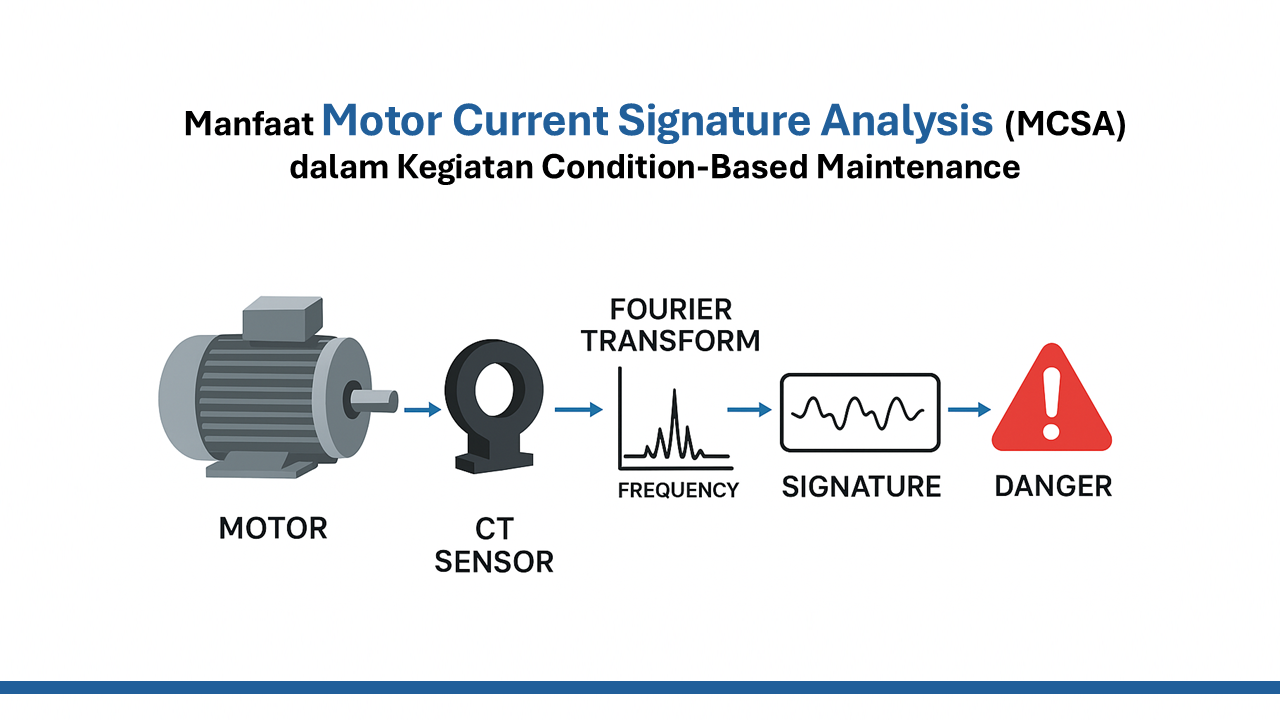
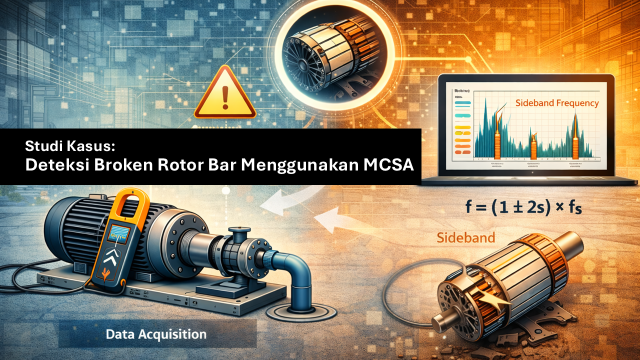
- A current sensor (current transformer/clamp meter) is installed on the motor's electrical panel.
- Current data is collected under steady-state conditions.
- Data collection is performed without disconnecting the power supply.
- Current data is analyzed using the Fast Fourier Transform (FFT).
This approach ensures that the analysis results represent the actual operating conditions of the motor.
Indications of a Broken Rotor Bar in the Current Spectrum
The results of the current spectrum analysis show the appearance of sideband frequencies around the main supply frequency. The characteristics of a broken rotor bar are identified through:
- Sidebands at frequency:
f = (1 ± 2s) × f?,
where s is the motor slip and f? is the supply frequency.
- Consistent increase in sideband amplitude compared to baseline data.
- Imbalance in the phase spectrum.
This pattern is a classic signature of a damaged rotor bar that is beginning to crack or break.
Analysis and Interpretation
Based on the MCSA results:
- The damage is still in its early stages
- It has not yet caused significant mechanical impact
- The potential for damage progression is quite high if the motor continues to operate without action
Trend analysis shows that the sideband amplitude has been increasing slowly over several weeks, indicating progressive rotor degradation.
Actions and Recommendations
Based on the MCSA findings, the maintenance team took the following steps:
- Schedule a rotor inspection during the planned shutdown
- Prepare a spare rotor to avoid prolonged downtime
- Conduct regular MCSA monitoring until the repair schedule is reached
When the motor was disassembled, several rotor bars were found to have microcracks that were not yet visible from the outside.
True Benefits of MCSA Implementation
This case study demonstrates the concrete benefits of MCSA, including:
- Early detection before total failure
- Prevention of unplanned downtime
- Savings in repair and production costs
- More accurate maintenance planning
- Improved reliability of critical assets
Without MCSA, damage would likely only be detected after a serious disruption to operations has occurred.
Lessons Learned from the Case Study
Several key points to take away:
- Broken rotor bars can occur without any initial mechanical symptoms
- MCSA is effective in detecting hidden electromechanical faults
- Trend analysis is far more important than a single measurement
- MCSA is particularly suitable for motors where vibration sensors are difficult to install
Motor Current Signature Analysis (MCSA) has proven itself to be a highly effective tool for early and non-intrusive detection of broken rotor bars. Through current spectrum analysis, potential failures can be identified long before they impact operations.
This case study confirms that MCSA is not simply a diagnostic tool, but a vital part of a modern predictive maintenance strategy focused on the reliability, efficiency, and sustainability of industrial operations.