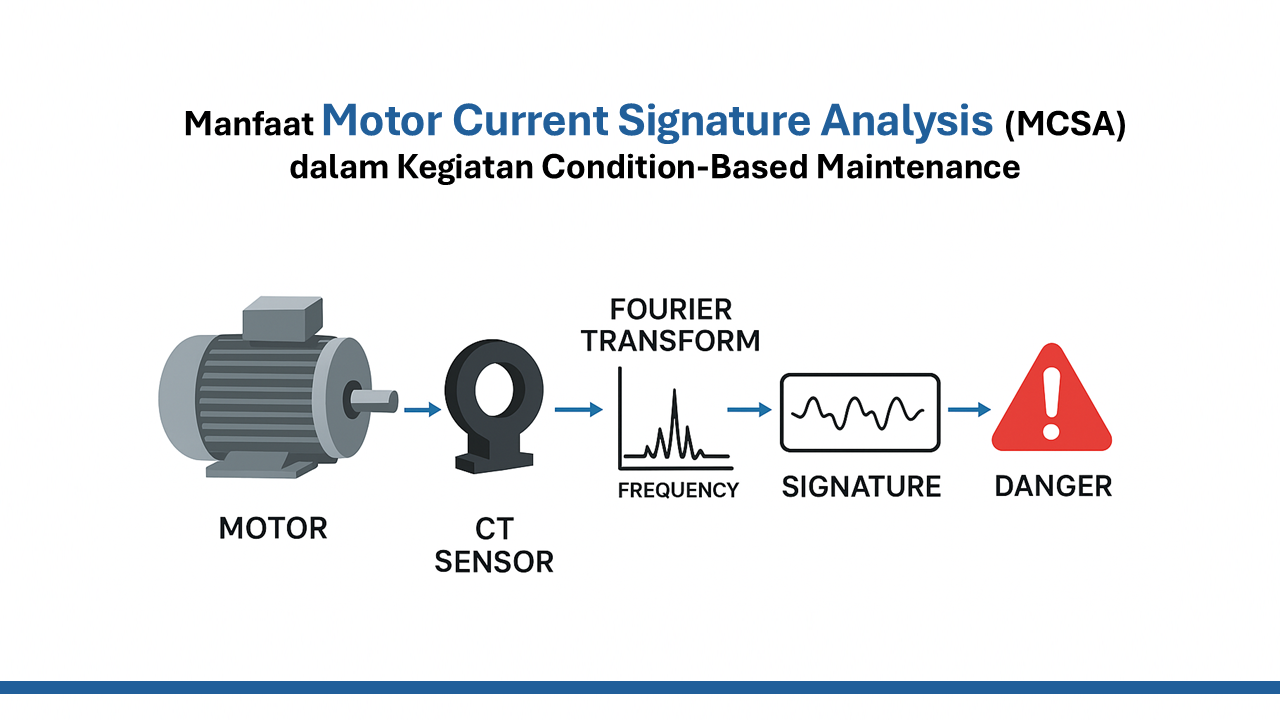
Electric motors are critical assets in various industrial processes. Damage to key components such as the rotor, stator, and bearings often develops slowly without obvious symptoms, ultimately leading to sudden failure. Motor Current Signature Analysis (MCSA) is an effective solution for early damage detection by analyzing the motor's electrical current in a non-intrusive, data-driven manner.
Why is Early Detection So Important?
Detecting damage at an early stage offers many benefits, including:
- Avoiding unplanned downtime
- Preventing further damage to other components
- Optimizing maintenance schedules
- Reducing repair and replacement costs
MCSA enables early detection without the need to stop the motor or dismantle the equipment.
Basic Principles of Motor Current Signature Analysis in Detecting Damage
Each electric motor has unique current characteristics. When a mechanical or electrical fault occurs, the motor's magnetic field and torque change. These changes modulate the current and generate characteristic frequencies that can be analyzed in the current spectrum using techniques such as the Fast Fourier Transform (FFT).
By understanding these frequency patterns, the type of damage can be identified early.
Detecting Rotor Damage Using Motor Current Signature Analysis
Types of Rotor Damage:
- Broken rotor bar
- Rotor crack
- Rotor casting problem
- Rotor imbalance
Indications in Motor Current
Rotor damage generally produces sideband frequencies around the fundamental frequency (line frequency). These sidebands are directly related to motor slip and are a hallmark of rotor faults.
Motor Current Signature Analysis is very effective in detecting rotor damage, even when mechanical vibration has not yet increased significantly.
Detecting Stator Damage Using Motor Current Signature Analysis
Types of Stator Damage
- Inter-winding shorts
- Inter-phase current imbalance
- Early stator insulation degradation
Indications in Motor Current
Stator faults affect the magnetic field distribution, causing:
- Current amplitude imbalance
- The appearance of certain harmonics
- Distortion in the frequency spectrum
With regular MCSA monitoring, stator problems can be detected before they progress to total motor failure.
Bearing Damage Detection Using Motor Current Signature Analysis
Bearing Detection Challenges
Bearing damage is often considered the domain of vibration analysis. However, bearing failures also affect motor torque and load, which are ultimately reflected in the electrical current.
Bearing Damage Indications
- Current modulation at the bearing's characteristic frequency
- Changes in current patterns due to abnormal friction
- Current fluctuations that follow the mechanical condition of the bearing
MCSA is very useful as an early warning, especially in conditions where installing vibration sensors is difficult.
Advantages of Motor Current Signature Analysis in Detecting Rotor, Stator, and Bearings
Some of the main advantages of MCSA in detecting motor component damage:
- Non-intrusive: No need to disassemble the motor
- Online monitoring: Data can be captured while the motor is operating
- Safe: Suitable for low- to medium-voltage motors
- Efficient: One measurement can provide information on multiple components
- Economical: Reduces the need for manual inspections and downtime
Integrating Motor Current Signature Analysis with Predictive Maintenance Programs
In a predictive maintenance strategy, MCSA serves as an initial diagnostic tool. Motor Current Signature Analysis data can be used to:
- Determine repair priorities
- Combine results with vibration analysis and oil analysis
- Generate component degradation trends
- Support risk-based maintenance decisions
This approach helps companies shift from reactive maintenance to more planned and reliable maintenance.
Motor Current Signature Analysis (MCSA) enables early detection of rotor, stator, and bearing failures simply by reading the motor's electrical current. With its ability to detect faults at an early stage, MCSA is a critical tool for maintaining motor reliability, reducing downtime, and improving operational efficiency.
In industrial environments that demand high reliability, MCSA is more than just an analytical method; it is a smart strategy for keeping electric motor assets healthy and productive.