In the modern industrial world, demands for equipment reliability are increasingly high. Downtime not only impacts lost production but also significant repair costs and potential safety risks. Therefore, the maintenance approach has shifted from reactive to predictive and proactive.
One of the keys to successful predictive maintenance is the effective implementation of condition monitoring. However, using a single method is often insufficient to provide a comprehensive picture of machine condition. This is where the importance of combining several monitoring methods lies, such as:
• Laboratory Analysis (Oil Analysis)
• Vibration Analysis
• Electric Signature Analysis (ESA)
The integration of these three methods allows companies to gain a more complete understanding of machine condition from a tribological, mechanical, and electrical perspective.
The Role and Characteristics of Each Method
1. Laboratory Analysis (Oil Analysis)
Oil analysis is a method that focuses on the condition of the lubricant and the particles contained within it. Commonly analyzed parameters include:
• Contamination level (ISO Cleanliness Code)
• Wear metal content (Fe, Cu, Al, etc.)
• Oil degradation (oxidation, viscosity)
This method is very effective as an early warning system, especially for detecting:
• Internal component wear
• Particle and water contamination
• Lubrication system failure
However, oil analysis is generally periodic and does not provide direct information regarding the specific location of the failure.
2. Vibration Analysis
Vibration analysis is used to detect the mechanical condition of machinery, particularly rotating equipment. This method can identify:
• Unbalance
• Misalignment
• Looseness
• Bearing and gear damage
The main advantage of vibration analysis is its ability to identify faults through frequency analysis. With the right technique, the source of the failure can be specifically determined. Its limitations are:
• Sensitivity to early wear is not always high
• Requires good interpretation skills
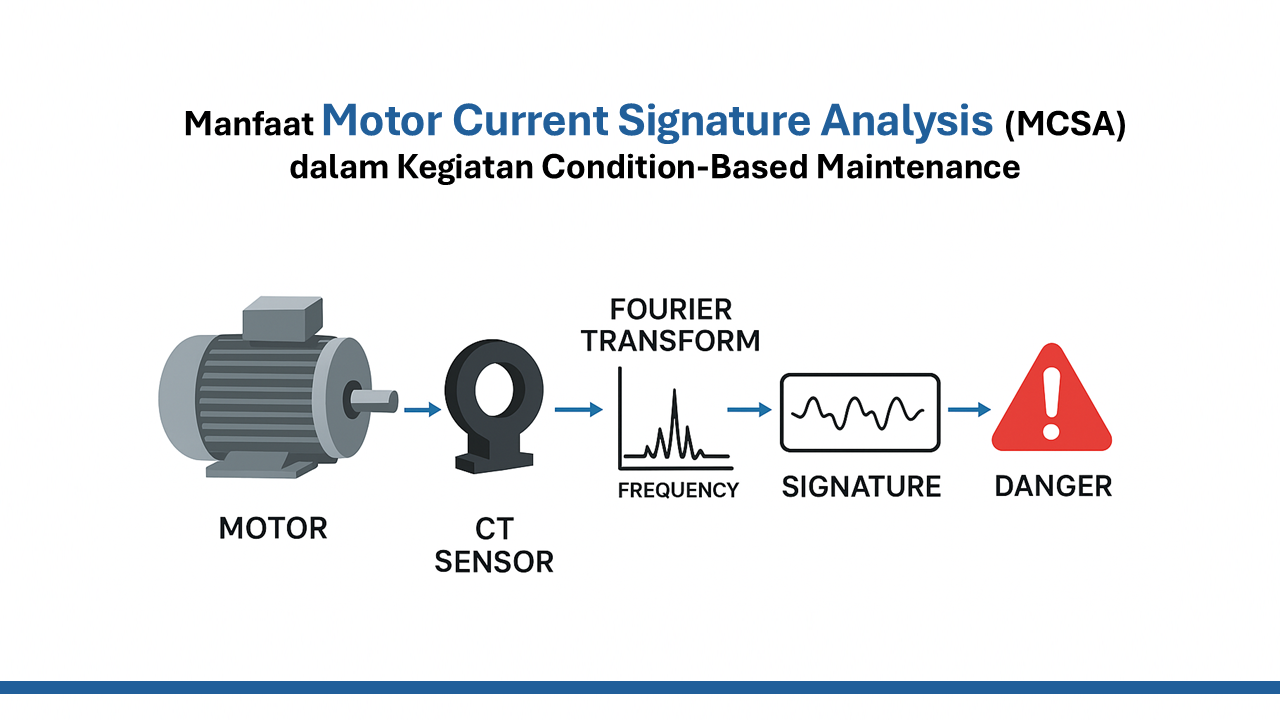
3. Electric Signature Analysis (ESA)
ESA is a method that analyzes current and voltage signals in electric motors. This method can detect:
• Rotor and stator damage
• Electrical imbalance
• Power supply disturbances
• Interactions between the motor and the load
ESA's advantage is its ability to view the overall system condition, including the relationship between the motor and the driven equipment. However, ESA does not provide information regarding lubrication conditions and particle wear.
Integration Concept: From Data to Insight
Combining these three methods is not simply about collecting more data, but rather creating correlations between parameters to gain more accurate insights.
For example:
• Oil analysis shows an increase in iron (Fe) particles
• Vibration analysis detects a typical frequency of bearing failure
• ESA shows a change in current pattern due to abnormal load
From this combination, it can be concluded that:
Bearing failure has occurred, affecting overall motor performance.
This approach is known as correlation-based condition monitoring, where decisions are made not from a single indicator, but from a combination of several methods.
Failure Mode-Based Approach
Effective integration should address the potential failure modes. Each method has its strengths in detecting specific types of failure.
A simple example:
• Lubrication failure → detected early by oil analysis
• Mechanical fault (misalignment, imbalance) → dominant in vibration
• Electrical fault → only detected by ESA
• Bearing failure → can be detected by all three methods using different approaches
By understanding this, companies can determine which method is:
• Leading indicator (early detection)
• Confirming indicator (damage validation)
Implementation Strategy
To achieve optimal results, condition monitoring integration needs to be carried out in stages:
1. Determining Critical Equipment
Not all equipment requires a combination of all three methods. Focus on:
• Equipment with a high production impact
• Machines with high downtime costs
• Complex systems (motor + gearbox + load)
2. Data Synchronization
Data from various methods must be on the same timeline for effective comparison.
Examples:
• Oil sampling: monthly
• Vibration: weekly or online
• ESA: periodic or continuous
3. Platform Integration
Ideally, all data is collected in a single system (CMMS or reliability platform) so that:
• Trending can be analyzed comprehensively
• Alarms based on a combination of parameters can be implemented
4. Competency Development
The success of integration depends heavily on the team's ability to:
• Analyze data across methods
• Understand the relationships between phenomena (tribological, mechanical, electrical)
Benefits of Integration
By combining oil analysis, vibration, and ESA, companies can achieve:
• More accurate early detection
• Clearer root cause analysis
• Reduced unplanned downtime
• Optimized maintenance costs
• Increased equipment lifespan
Integrating condition monitoring methods is a strategic step in improving machine reliability. Each method has its advantages and limitations, but when combined, they provide a complementary perspective.
This approach enables companies to not only recognize that a failure has occurred, but also understand why the failure occurred, how it progressed, and when action should be taken. Ultimately, the success of condition monitoring is not determined by the amount of data available, but by the ability to transform that data into actionable insights.