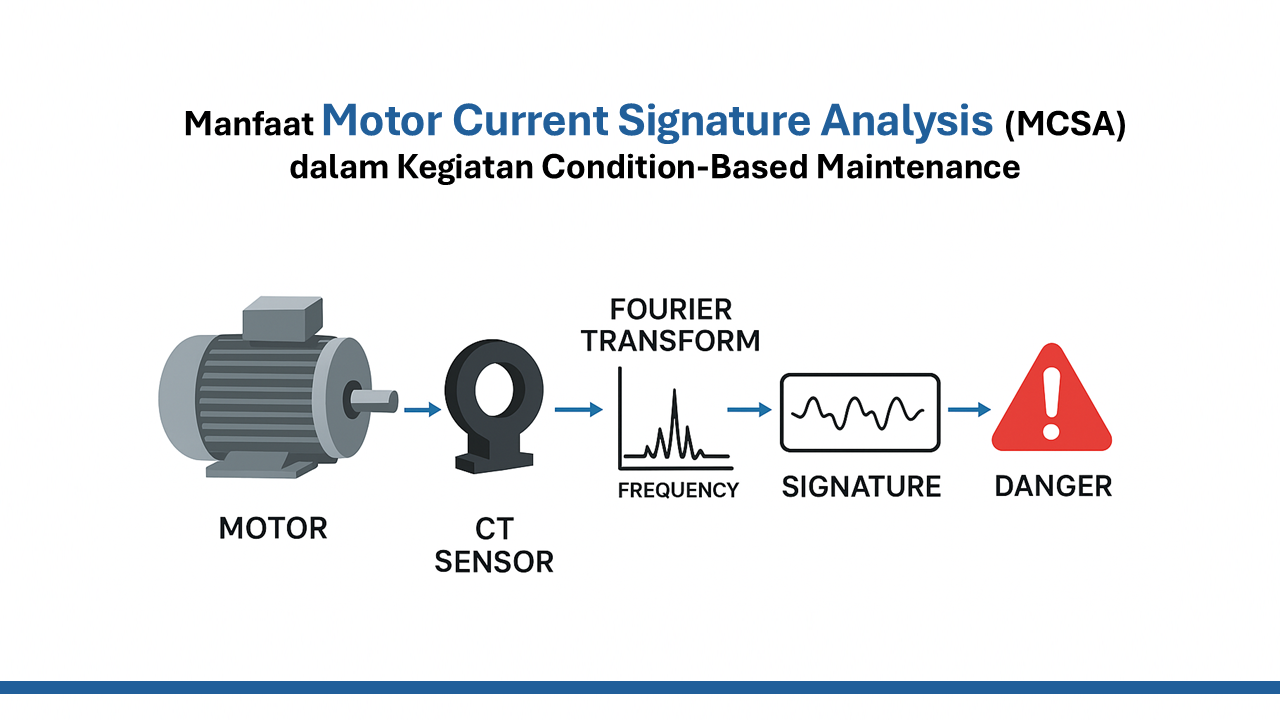
In modern industrial environments, electric motor reliability is a key factor in the continuity of production processes. Undetected motor failures can cause sudden downtime, subsequent damage, and significant operational losses. To address these challenges, Motor Current Signature Analysis (MCSA) is an effective, safe, and data-driven predictive maintenance technique.
What is Motor Current Signature Analysis (MCSA)?
Motor Current Signature Analysis (MCSA) is a condition monitoring method that utilizes analysis of a motor's electrical current to assess the health of the motor and the mechanical systems it drives. This technique is based on the principle that any electrical or mechanical disturbance in a motor will affect the current characteristics, whether in terms of amplitude, frequency, or specific modulation patterns.
By analyzing the current's frequency spectrum, MCSA can identify early indications of damage that often do not yet produce significant vibration or noise.
MCSA Working Principle
Electric motors generate a rotating magnetic field that is directly affected by the electric current. When disturbances such as imbalance, component damage, or load fluctuations occur, the magnetic field becomes distorted. This distortion is then reflected in the motor's current pattern.
Using signal transformations (such as the Fast Fourier Transform/FFT), the current signal is converted into a frequency spectrum. This spectrum reveals characteristic frequencies that serve as indicators of the type and severity of the fault.
Types of Faults That Can Be Detected with MCSA
As a comprehensive diagnostic technique, MCSA can detect various types of faults, including:
1. Rotor Faults
- Broken rotor bars
- Rotor cracks
- Rotor casting problems
Rotor faults produce sideband frequencies around the fundamental frequency that can be clearly identified using MCSA.
2. Stator Faults
- Inter-winding shorts
- Phase imbalance
- Early insulation degradation
MCSA provides early warning before total motor failure occurs.
3. Mechanical Faults
- Bearing failure
- Misalignment
- Unbalance
Mechanical faults affect motor torque and manifest as specific modulations in the electrical current.
4. Load and Process Faults
- Pump cavitation
- Abnormal valve or damper performance
- Conveyor jamming or slippage
MCSA monitors not only the motor but also the process conditions connected to it.
The Advantages of MCSA in Predictive Maintenance
Within the Predictive Maintenance framework, MCSA has several strategic advantages:
- Non-Intrusive and Safe
Measurements are made from the electrical panel using a current clamp without the need to stop the machine or dismantle the motor.
- Suitable for Critical Motors
Ideal for high-power, medium-voltage motors, and motors operating continuously.
- Effective for Motors with VFDs
With the right analysis techniques, MCSA remains relevant for motors controlled by Variable Frequency Drives.
- Relatively Low Implementation Costs
Compared to periodic overhauls or reactive inspections, MCSA provides high economic value.
- Supports Data-Driven Decisions
Historical motor current data can be trended to predict failure times and plan optimal maintenance.
The Role of MCSA in a Predictive Maintenance Strategy
MCSA is a key pillar of Condition-Based Predictive Maintenance. With regular or online monitoring, maintenance teams can:
- Identify degradation at an early stage
- Prioritize repairs based on risk level
- Reduce unplanned downtime
- Extend the life of motors and related equipment
When combined with Vibration Analysis, Oil Analysis, and other Electrical Signature Analysis techniques, MCSA provides a more comprehensive and accurate picture of asset condition.
When Is MCSA Best Used?
MCSA is highly recommended for:
- Critical motors that are difficult to stop
- Applications with limited mechanical access
- Long-term reliability and asset management programs
- Power generation, oil & gas, cement, pulp & paper, and heavy manufacturing industries
Motor Current Signature Analysis (MCSA) is a motor current analysis technique proven effective in supporting modern Predictive Maintenance. With its ability to detect faults early, non-intrusively, and data-driven, MCSA helps industries transform from reactive maintenance to more reliable, efficient, and sustainable maintenance strategies.
Understanding and implementing MCSA means listening to the motor's condition through its electrical current, so any potential problems can be anticipated before they develop into major failures.