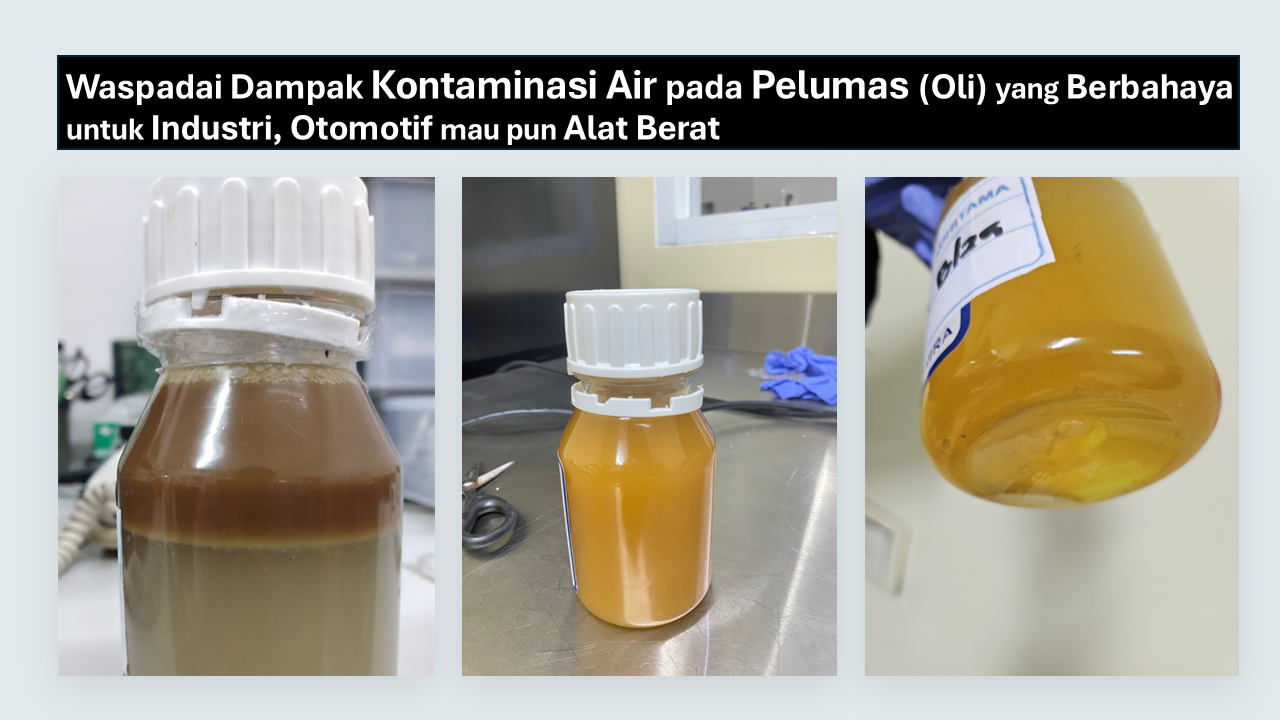
Lubricants or oil are crucial components in maintaining the performance and lifespan of machines, whether in the industrial, automotive, or heavy equipment sectors. However, one hidden threat that is often overlooked is water contamination in lubricants. Even in small amounts, the presence of water can cause serious damage and result in significant losses if not addressed quickly and appropriately.
Why Does Water Enter Lubricants?
Water can enter the lubrication system in various ways, including:
- Condensation (rapid temperature changes)
- Seal or gasket leaks
- Washing processes or humid environments
- Coolant leaks into the lubrication system
Dangerous impacts of water contamination on lubricants:
1. Reduced lubricating ability
• The presence of water disrupts the oil film (lubricating layer), reducing its function as a separator between metal surfaces.
• Increased friction → accelerated component wear.
• Oil viscosity decreases (becomes thinner).
2. Corrosion & Rust
• Water + metal → oxidation reaction → rust formation.
• Corrosion shortens the life of bearings, gears, and other engine components.
3. Sludge & Emulsion Formation
• Water mixed with oil can form sludge or emulsion.
• Sludge clogs filters, oil lines, and disrupts lubrication flow.
4. Additive Deterioration
• Water can break down or destabilize lubricant additives (e.g., antiwear, antioxidants, dispersants).
• This results in decreased lubricant performance.
5. Cavitation & Foam
• High water content can turn into vapor under high pressure, causing cavitation.
• Water can also cause lubricant foaming, reducing lubrication effectiveness.
6. Increased wear and premature failure
• The combined effects above lead to accelerated wear, potential engine damage, downtime, and higher repair costs.
Conclusion:
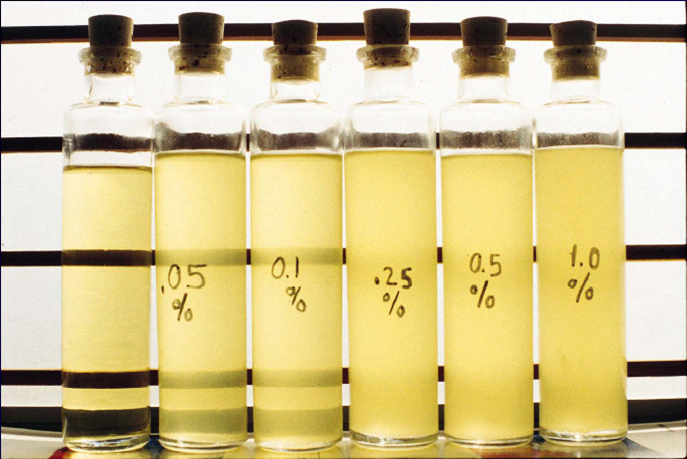
Water is a dangerous contaminant for lubricants — even in small amounts (e.g., <0.1%).
• Regularly monitor the oil's water content, for example using the Karl Fischer method, is recommended.
• Perform preventative maintenance: check seals, avoid drastic temperature changes, and use breathers.
For more information about this article or Karl Fischer, please contact PT Hyprowira Adhitama, Mettler Toledo's distributor in Indonesia.