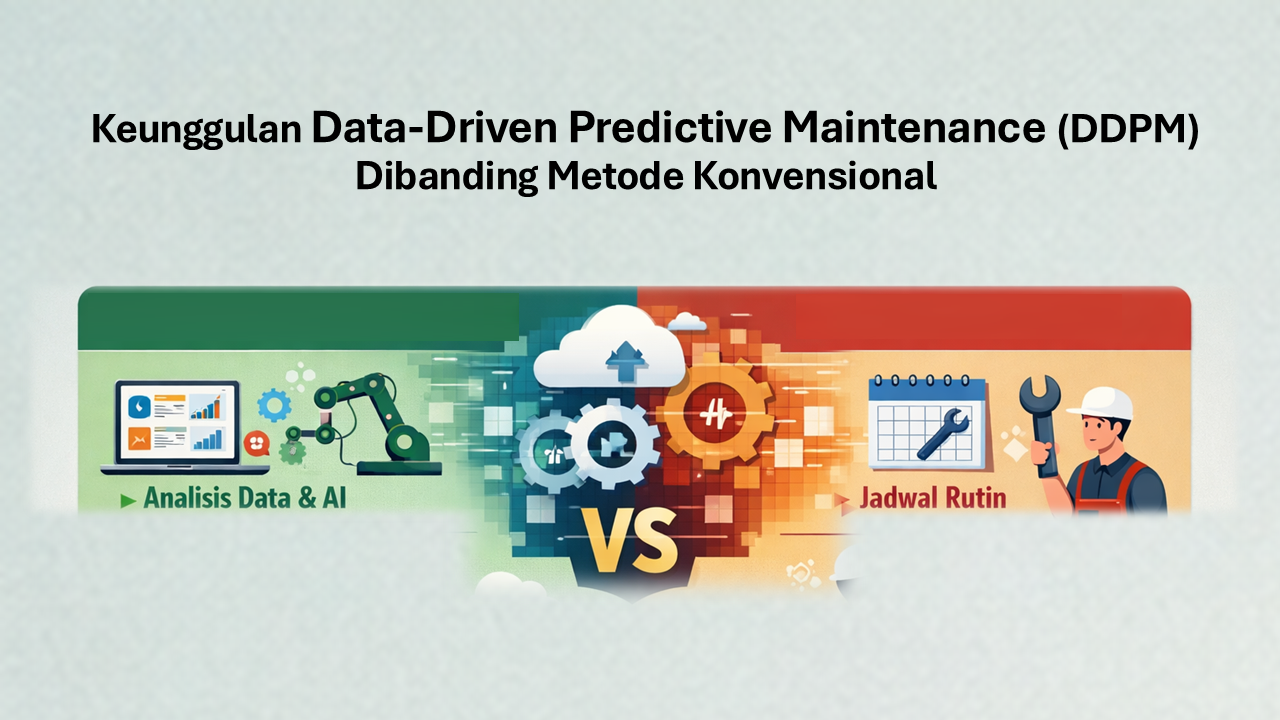
Here are some of the advantages:
1. Downtime (Production Downtime)
Data-Driven Predictive Maintenance (DDPM)
• Uses real-time sensors, machine learning, and historical patterns to detect failures before they occur.
• Reduces unplanned downtime by 30-50%.
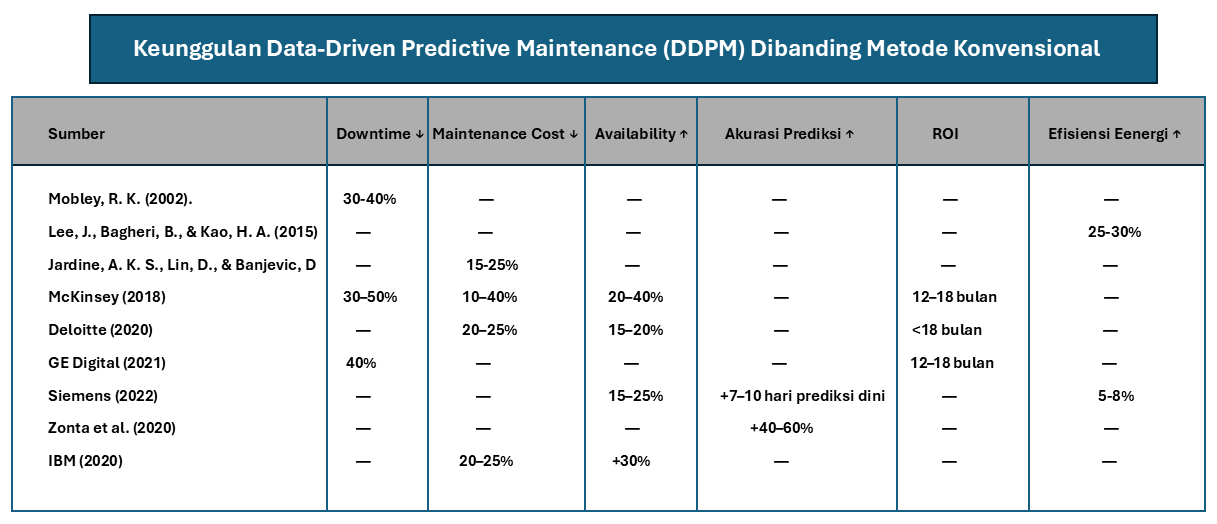
- Mobley, R. K. (2002): 30-40% (*1)
- McKinsey & Company (2018): 30-50% (*5)
- GE Digital (2021): 40% (*7)
• Schedules repairs during low production times to minimize disruptions.
Conventional Methods
• Failures are often detected after they occur (reactive).
• Preventive maintenance is based on working hours, potentially requiring service even when equipment is still healthy.
• Unplanned downtime remains high.
Benefits of Data-Driven Predictive Maintenance (DDPM): Very significant. Faster detection of abnormalities, avoiding total breakdowns.
2. Maintenance Cost
Data-Driven Predictive Maintenance (DDPM)
• Optimizes maintenance time — only servicing when significant degradation is detected.
• Reduces unnecessary spare part costs.
• Reduces technician overtime.
• Potential reduction in maintenance costs by 10-40%.
- Jardine, A. K. S., Lin, D., & Banjevic, D. (2006). Maintenance costs decrease by 15-25%. (*3)
- McKinsey & Company (2018). Maintenance costs decrease by 10-40%. (*5)
- Deloitte Insights (2020). Maintenance costs decrease by 20-25%. (*6)
- IBM Institute for Business Value (2020). Maintenance costs decrease by 20–25% (*9)
Conventional Methods
• Routine preventive maintenance = risk of over-maintenance.
• Breakdown maintenance = high costs, including further damage.
Advantages of Data-Driven Predictive Maintenance (DDPM): Measurable and sustainable cost savings
3. Availability (Equipment Availability)
Data-Driven Predictive Maintenance (DDPM)
• Increases equipment availability due to fewer breakdowns and faster repairs.
• Availability increases by 15–40%, especially for critical machines.
- McKinsey & Company (2018). Equipment life increases by 20–40%. (*5)
- Deloitte Insights (2020). Increases asset uptime by 15–20%. (*6)
- Siemens Industrial AI Report (2022). System reliability increases by 15–25%. (*8)
- IBM Institute for Business Value (2020). Increase equipment availability by up to 30% (*9)
Conventional Methods
• Availability decreases due to sudden repairs and suboptimal maintenance intervals.
Advantages of Data-Driven Predictive Maintenance (DDPM): Much more stable equipment availability
4. Prediction Accuracy
Data-Driven Predictive Maintenance (DDPM)
• Uses AI/ML algorithms, analyzes vibration patterns, temperature, electrical current, oil analysis, etc.
• Generates highly accurate Remaining Useful Life (RUL) predictions (depending on data quality).
- Zonta, T. et al. (2020). Increases prediction accuracy by 40–60% (*4)
- Siemens Industrial AI Report (2022). Predicts bearing failures 7–10 days earlier (*8)
• Able to identify anomalies invisible to technicians.
Conventional Methods
• Relies on manual inspection and technician experience.
• Accuracy varies widely and is generally low for detecting early failures.
Advantages of Data-Driven Predictive Maintenance (DDPM): Predictions are much more accurate and objective.
5. ROI (Return on Investment)
Data-Driven Predictive Maintenance (DDPM)
• High ROI due to a combination of:
o Reduced downtime
o Reduced maintenance costs
o Longer asset lifespan
o More stable production
• Industry studies show ROI of 3x to 10x in 12–24 months.
- GE Digital (2021). Achieved in 12–18 months (*7)
- Deloitte Insights (2020). Achieved in less than 18 months (*6)
- McKinsey & Company (2018). Achieved in 12–18 months (*5)
Conventional Methods
• Low ROI due to high breakdown costs and low efficiency.
Advantages of Data-Driven Predictive Maintenance (DDPM): Fast and significant return on investment
6. Energy Efficiency
Data-Driven Predictive Maintenance (DDPM)
• Worn and unhealthy machines typically waste energy (increased current, increased friction, and increased temperature).
• DDPM detects inefficient conditions earlier, resulting in faster repairs.
• Energy efficiency increases by 25–30%, especially for large electric motors, pumps, and compressors.
- Lee, J., Bagheri, B., & Kao, H. A. (2015). Increases efficiency by 25–30%. (*2)
- Siemens Industrial AI Report (2022). Increases by 5–8% (*8)
Conventional Methods
• Energy waste is not detected until the problem becomes major or the machine fails.
Advantages of Data-Driven Predictive Maintenance (DDPM): More efficient operations, lower electricity costs
*Source:
1. Mobley, R. K. (2002). An Introduction to Predictive Maintenance.
2. Lee, J., Bagheri, B., & Kao, H. A. (2015). “A Cyber-Physical Systems architecture for Industry 4.0-based manufacturing systems.” Manufacturing Letters, 3, 18–23.
3. Jardine, A. K. S., Lin, D., & Banjevic, D. (2006). “A review on machinery diagnostics and prognostics implementing condition-based maintenance.” Mechanical Systems and Signal Processing, 20(7), 1483–1510.
4. Zonta, T. et al. (2020). “Predictive maintenance in the Industry 4.0: A systematic literature review.” Computers in Industry, 123, 103289.
5. McKinsey & Company (2018). “Smartening up with Artificial Intelligence (AI) – What’s in it for Germany and its Industrial Sector?”
6. Deloitte Insights (2020). “Predictive maintenance and the smart factory.”
7. GE Digital (2021). “Predix Asset Performance Management: The Economics of Predictive Maintenance.”
8. Siemens Industrial AI Report (2022). “Predictive Services for Drive Systems.”
9. IBM Institute for Business Value (2020). “The Future of Predictive Maintenance with AI.”