The rotor in an induction motor is a component that operates under extreme conditions: rotating at high speeds, exposed to changing loads, and exposed to strong electromagnetic fields. Minor damage such as broken rotor bars, eccentricity, or air-gap variation can cause excessive vibration, overheating, increased energy consumption, and even motor failure. To prevent this, current-based monitoring techniques are now one of the most effective, economical, and non-intrusive methods.
Unlike mechanical methods such as vibration analysis, current-based techniques utilize the current signals already present in the motor. Without installing additional sensors, analysts can detect rotor faults simply by reading the stator current pattern and analyzing the resulting frequency anomalies. This makes this method very practical for industries requiring real-time online monitoring.
Basic Principles of Current-Based Rotor Monitoring
Induction motors operate based on the interaction of the stator and rotor magnetic fields. When the rotor experiences damage, this interaction is disrupted, resulting in characteristic changes in the electric current, such as:
- The appearance of certain harmonics
- Current waveform distortion
- Rotor characteristic frequency sidebands
- Changes in the stator current vector
By analyzing these changes, rotor conditions can be identified without shutting down the machine or installing additional sensors.
Main Methods for Current-Based Rotor Monitoring
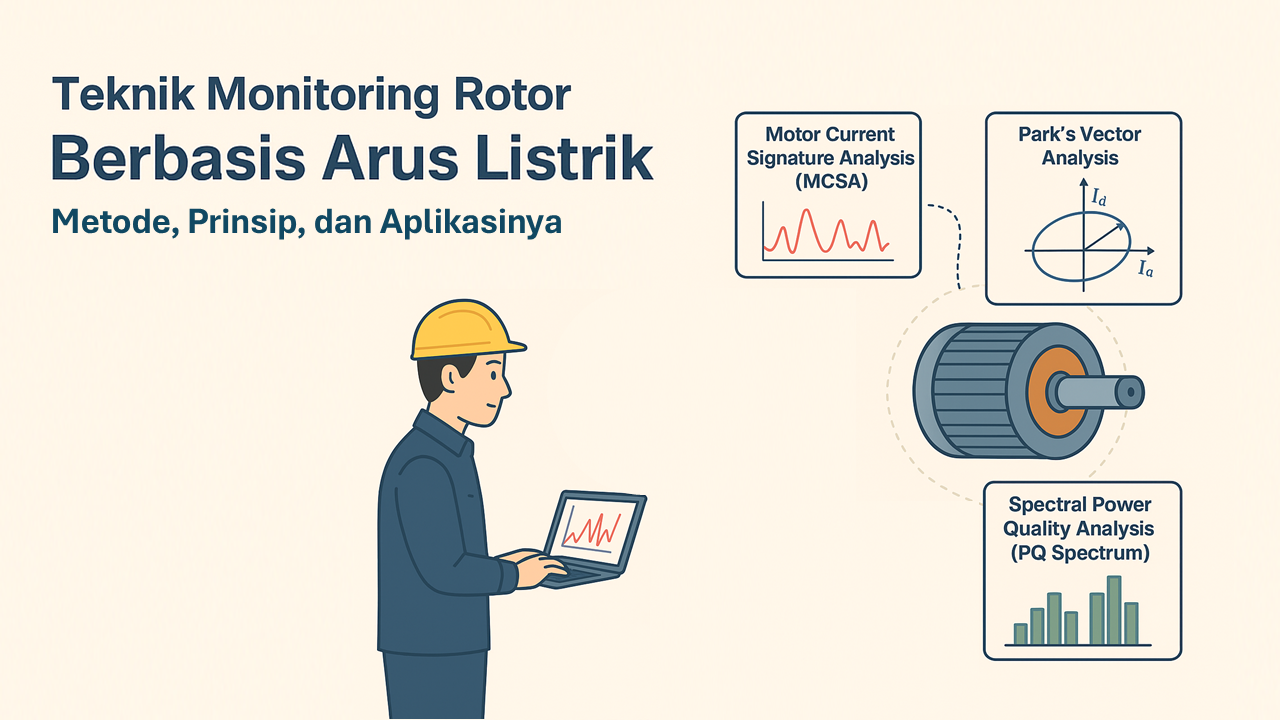
A. Motor Current Signature Analysis (MCSA)
This is the most popular and robust method for non-intrusively detecting rotor faults.
How MCSA Works
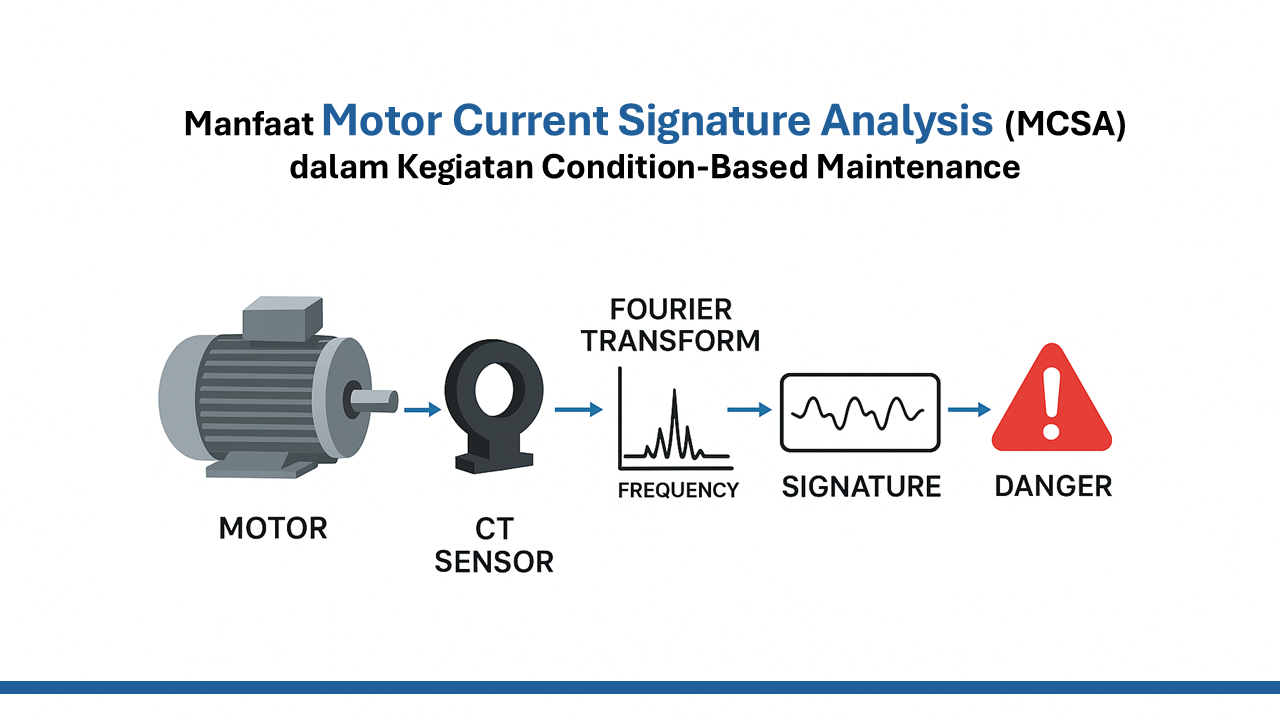
MCSA analyzes the stator current signal using the FFT (Fast Fourier Transform) to find sideband frequencies around the main frequency:

where s is the motor slip.
Detectable faults:
- Broken rotor bar (most accurate)
- Rotor eccentricity
- Air-gap variation
- Bent shaft (indirect effect)
- Slip abnormalities
MCSA is highly sensitive to electromagnetic disturbances originating from the rotor, so it is often used as the primary method for rotor fault detection.
B. Park's Vector Analysis (Park Vector)
Park Vector maps the three-phase current (Ia, Ib, Ic) into two components:
- Id (direct axis current)
- Iq (quadrature axis current)
The results are then plotted as an ellipse, circular, or distorted loop.
Rotor fault indicators using Park Vector:
- Ellipse shape distortion → broken bar
- Wavy pattern → dynamic eccentricity
- Pattern irregularity → electromagnetic imbalance
This method is highly visual and used for rapid diagnosis.
C. Spectral Power Quality Analysis (PQ Spectrum)
PQ Spectrum analyzes harmonics in the power system to identify the effects of rotor damage.
Rotor fault indicators:
- Increased low harmonics (2nd, 3rd)
- Changes in sideband harmonic amplitude
- Waveform distortion (increased THD)
Although not the primary method, PQ Spectrum is very useful as additional verification.
D. Instantaneous Power Analysis
This technique combines current and voltage signals to view the instantaneous power waveform.
Can detect:
- Rotor asymmetry
- Eccentricity
- Slip-related anomalies
- This method is more sophisticated and requires a high-speed data acquisition system.
Advantages of Current-Based Rotor Monitoring
Why are many industries now turning to this method?
1. Non-intrusive
No need to install sensors on the motor or stop operation.
2. Economical
Uses current signals already available in the MCC (Motor Control Center).
3. Can be performed online and in real time
Suitable for predictive maintenance and remote monitoring.
4. Sensitive to electromagnetic interference
Rotor damage is often detected in current more quickly than vibration.
5. Easy to integrate with IoT & AI systems
Current data can be sent to the cloud for machine learning modeling.
Industrial Applications
This technique is used in: Chemical and petrochemical plants, Power Generation, Mining, Pump and compressor systems, HVAC, fans, and high-power motors, Automotive test benches
In many industries, current-based monitoring serves as the first layer of protection before analyzing vibration data.
The Best Combination for Maximum Accuracy
While powerful, current-based methods become highly accurate when combined with:
- Vibration analysis (for mechanical faults)
- Thermal imaging (for overheating)
- Acoustic emission
- AI-based anomaly detection
The combination of current and vibration provides the most comprehensive picture of electrical and mechanical performance.
Current-based rotor condition monitoring is a highly effective, inexpensive, safe, and real-time technology. Methods such as MCSA, Park Vector, and Power Quality Spectrum can detect various rotor faults without the need for direct shaft measurements or the installation of additional sensors. This technique is now an essential part of modern predictive maintenance strategies because it facilitates early detection and reduce downtime, and increase the reliability of rotating machinery.