
It would be very troublesome if the factory machines that you normally use for production suddenly experience problems and malfunctions. In addition to hampering the production process, repairing problematic machines is sure to cost a fortune. This will cause financial and operational losses. Therefore, you need to do maintenance (maintenance) periodically on factory machinery, especially machines that depend on the work of the driving shaft. One of them is with engine alignment.
What is Alignment Machine?
Engine alignment is the process of aligning or aligning two axes so that the symmetry between the driving shaft and the axis of the shaft that is driven by two pedestals can be interconnected. Although referred to as the process of aligning two axes of the shaft, in reality, the two axes of the machine cannot have a 100% straight accuracy rate. There is a tolerance of less than 0.05 mm for the alignment of the two axes of the engine shaft.
Alignment goes into mandatory maintenance or maintenance for the machine to maintain its reliability and age. This process can be done periodically to ensure the engine shaft rotates on each axis that fits. Do not let you neglect engine maintenance by forgetting the alignment process because this will endanger the performance of the machine and your production process.
Why Do You Need To Alignment A Machine?
Imagine how it would be if there were two axes rotating at each other, but the two axes were not parallel. Surely friction and vibration will be created which will damage the machine itself. If friction and vibration are more frequent, it is not impossible that the engine life will be shorter. Rust will also appear faster on machines that spin incorrectly between their axes.
The advantages of aligning the factory machine include:
- Machines that are routinely aligned will be more reliable so they can operate according to the desired target age.
- Reducing maintenance costs because there is no early damage resulting in lost production and the cost of repairing spare parts.
- Achieve production costs in accordance with the plans that have been made. You do not need to pay extra for unexpected damage from the machine.
- Alignment reduces excess axial and radial loads on the bearing to obtain longer bearing life.
- Reduces the possibility of a broken shaft due to cyclic fatigue.
- Reduces wear on the clutch components.
- Save up to 5% power usage.
- Creating a lower vibration level in the engine casing, bearing housing and rotors.
- Reducing the shaft bend from the power transmission point on the clutch to the bearing.
- Reducing the appropriate internal clearance rotor.
How to Align Factory Machine?
Based on the work equipment used, there are four kinds of alignment methods. First, there is the ruler method, which is the simplest and longest method to use. You do this by using a ruler to align the shaft with the same diameter. Second, there is a dial indicator method which is done by turning one axis or both axes simultaneously.
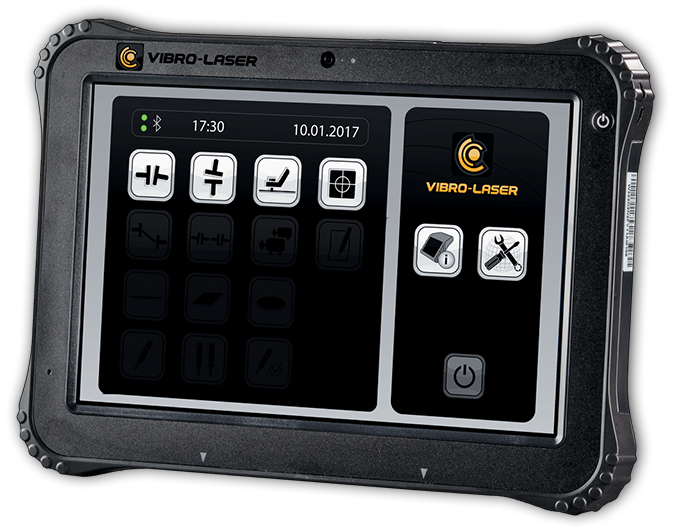
Third, there is a laser alignment method, namely by using an infrared laser beam to align the axis to be symmetrical, while simultaneously testing the level of symmetry of an object. Fourth, there is a level precision method that is used to adjust the level of flatness with maximum accuracy results.
To get accurate and perfect engine alignment results, you definitely need to choose the right method. At present, the laser shaft alignment method that uses infrared light to align the two shafts of the machine is considered the most accurate and the fastest. Two shafts can be directly symmetrical and you can test their symmetry. Get laser shaft alignment on Hyprowira!