
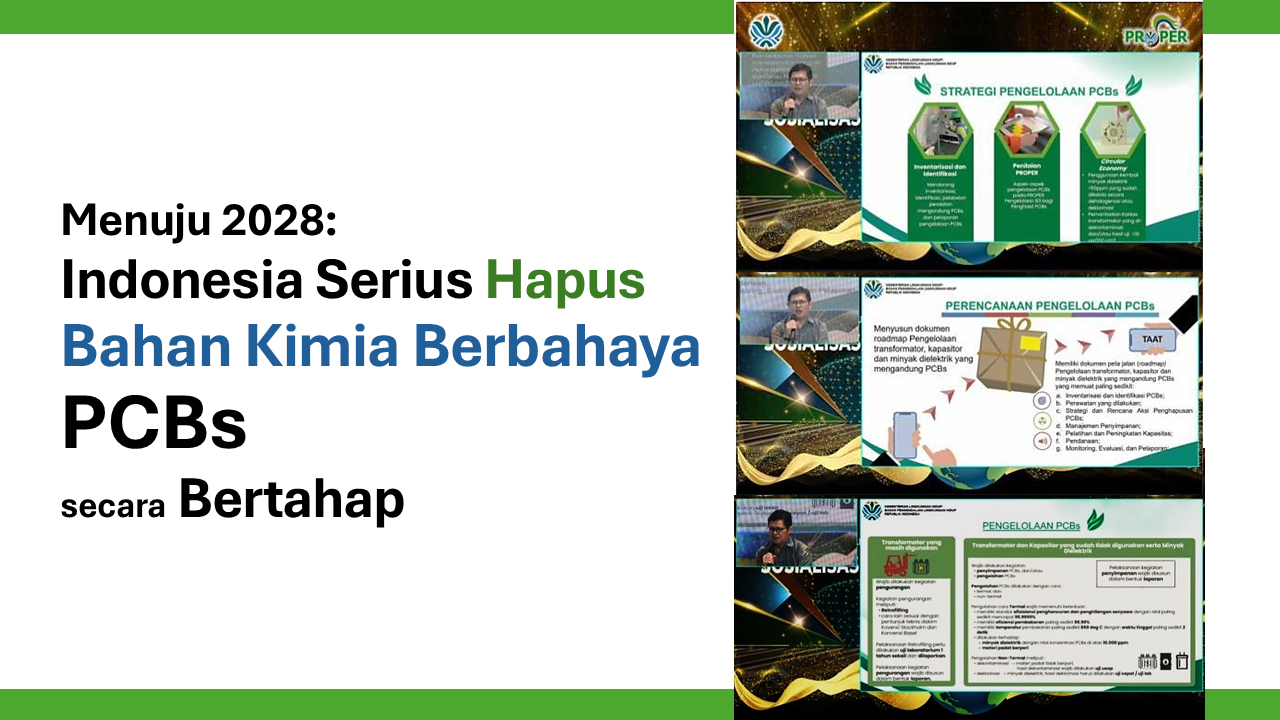
The Indonesian government, through the Ministry of Environment (KLH), has increased the urgency of managing Polychlorinated Biphenyls (PCBs) by making it a core criterion in PROPER 2024-2025. This indicates that PCBs, a persistent carcinogenic compound once widely used in transformers, are now a mandatory challenge for all companies.
In line with the Stockholm Convention Commitments and Ministerial Regulation No. 29 of 2020, Indonesia is targeting a total elimination of PCBs by 2028. To achieve this, businesses are required to:
1. Rapid Identification and Inventory: All transformers and capacitors, especially those manufactured before 1997, must be inspected immediately. Accurate laboratory testing is mandatory if the nameplate is unclear, not solely relying on rapid testing.
2. Preparation of a Management Roadmap: Companies must create a concrete action plan through 2028, including an inventory list, management strategy (retrofitting or destruction), schedule, allocation, funding, and personnel training.
The management method is "Retrofitting" for transformers still in use (replacing PCB-contaminated oil to below 50 ppm), while unused transformers/capacitors must be classified as B3 Waste and managed by a licensed third party.
The Ministry of Environment and Forestry emphasizes that PCB management is a social responsibility and a long-term investment for public health and industrial sustainability. The time limit until 2028 is increasingly pressing, demanding proactivity and responsibility from the business world to "deactivate this silent time bomb" for a safer future.
Reference Source:
- KLH-BPLH (2025, January 24). Socialization of PROPER 2025 Mechanisms, Criteria, and Reporting. YouTube.


