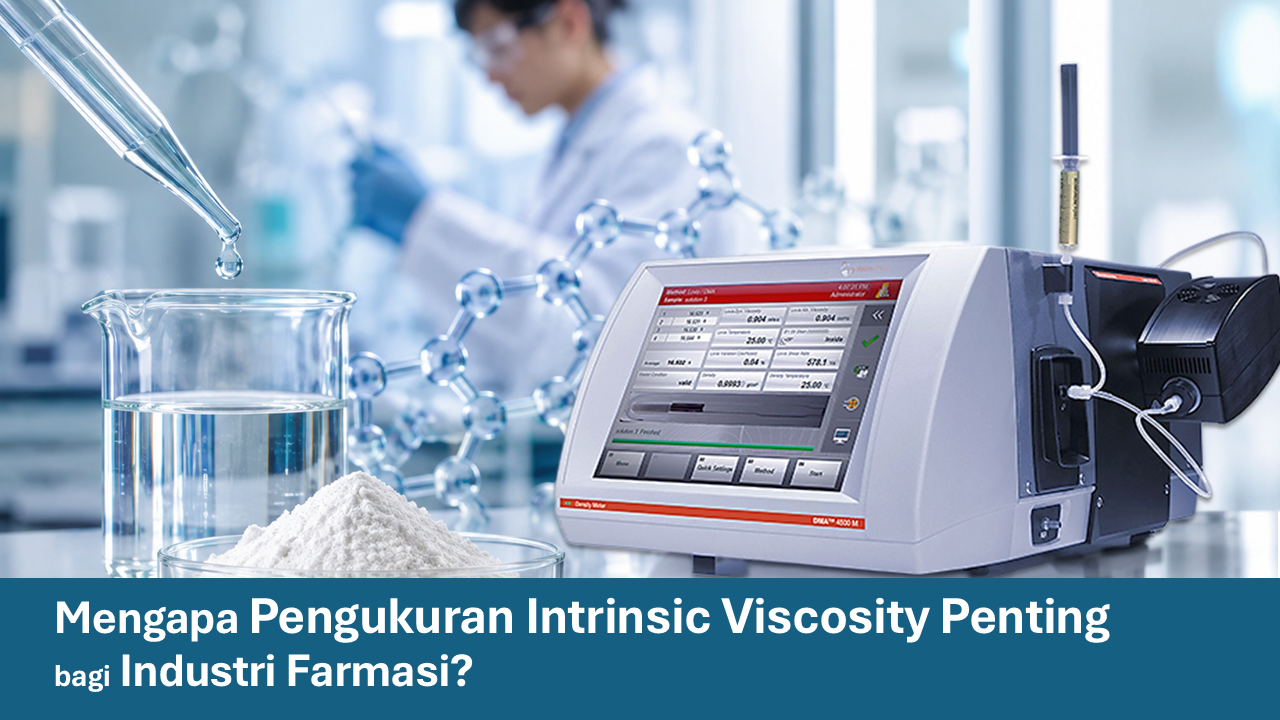
In the pharmaceutical industry, the quality of raw materials is a critical factor that determines product consistency and safety. One parameter that must be considered when testing polymer-based materials is Intrinsic Viscosity. This parameter plays a key role in the characterization of polymers, including Sodium Hyaluronate, which is widely used in pharmaceutical and medical products.
Sodium Hyaluronate is the sodium salt of Hyaluronic Acid and has a diverse range of applications—from serving as an active pharmaceutical ingredient or excipient to being used in injectable products for joint disorders and as a filler in medical aesthetic procedures. Consequently, its quality must be tested in accordance with applicable standards. The European Pharmacopoeia, for instance, mandates Intrinsic Viscosity as a required testing parameter for Sodium Hyaluronate, and this value must be included on the material's label.
What Is the Role of Intrinsic Viscosity in Polymer Testing?
Intrinsic Viscosity is a parameter used to characterize the properties of a polymer in solution. It is measured by comparing the viscosity of a polymer solution to that of a pure solvent across several concentration levels.
The results of this measurement provide insights into the characteristics of the polymer and can serve as a basis for calculating its molar mass. Thus, Intrinsic Viscosity is an essential parameter for the characterization and quality control of polymer raw materials within the pharmaceutical industry.
To ensure consistent results, the measurement process requires an appropriate methodology, strictly controlled temperature conditions, and instrumentation capable of delivering highly reproducible data.
More Practical Measurement with the Anton Paar Lovis 2000 M
For Intrinsic Viscosity measurements, the Anton Paar Lovis 2000 M offers a solution based on "rolling ball" viscometry technology. This instrument measures the time it takes for a ball to travel through a capillary tube filled with the sample. The travel-time data for both the solution and the solvent are then used to determine the relative viscosity and calculate specific polymer parameters. The Lovis 2000 M is equipped with specialized software for polymer analysis, capable of automatically calculating intrinsic viscosity and molar mass. Its "Zero Shear Scan" feature allows for measurements at multiple angles, enabling the extrapolation of values to zero shear rate conditions.
The reliability of its measurements is demonstrated by Anton Paar’s testing on sodium hyaluronate. Seven consecutive measurements of the same sample yielded an RSD (Relative Standard Deviation) of 1.35%, indicating excellent measurement repeatability.
Supporting Pharmaceutical Laboratory Testing Requirements
With its precise measurement capabilities, low sample volume requirements, and automated calculation of polymer parameters, the Anton Paar Lovis 2000 M serves as an ideal solution for intrinsic viscosity testing in pharmaceutical laboratories.
As an Anton Paar sub-distributor in Indonesia, Hyprowira Adhitama provides viscosity analysis solutions designed to help laboratories enhance testing reliability and the quality control of raw materials.
Entrust your laboratory’s viscosity measurement needs to the technological solutions of Anton Paar, provided by Hyprowira Adhitama.