
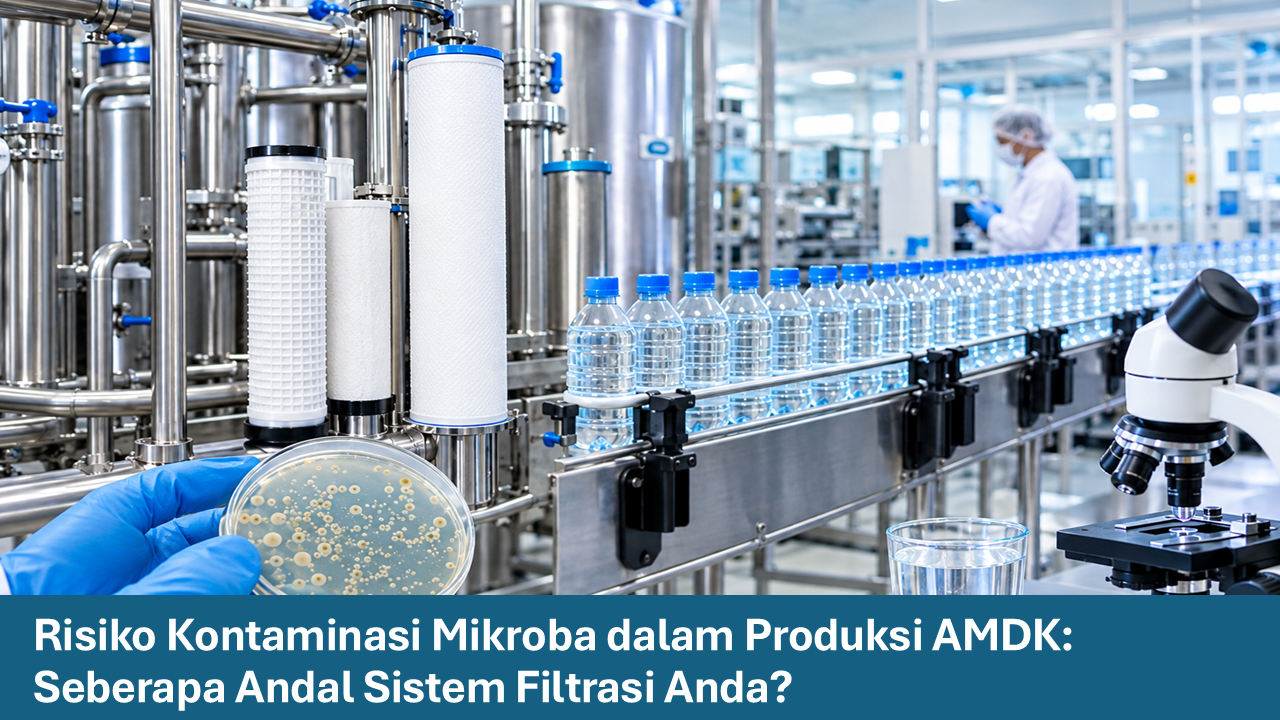
Microbiological safety is one of the most critical aspects of producing bottled drinking water. Consumers expect drinking water that is safe, clean, and meets quality standards. To meet these expectations, producers must not only ensure the quality of the raw water but also maintain the reliability of every stage of the treatment process—from pretreatment and filtration to filling and packaging.
Microbial contamination can occur if process controls are not functioning optimally. Potential sources include raw water, equipment surfaces, piping systems, storage tanks, or filling areas where hygiene is not properly maintained. Consequently, while a reliable filtration system is a key component in managing microbiological risks, it must be supported by rigorous sanitation, water quality monitoring, and comprehensive process control.
Why Is Microbial Contamination a Challenge in Bottled Water Production?
Water that appears clear is not necessarily free from microorganisms. Bacteria and other microorganisms can be present in water without causing any noticeable changes in color, odor, or taste.
Within water treatment systems, certain microorganisms can form biofilms—layers of microorganisms that adhere to surfaces and become embedded in a matrix they produce themselves. If operational conditions and sanitation are not well-controlled, biofilms can develop on the surfaces of pipes, tanks, valves, and other system components.
The presence of biofilms can lead to recurring contamination and make the cleaning process significantly more difficult. Furthermore, fluctuations in the quality of raw water can increase the treatment load and affect the performance of the filtration system.
These challenges demonstrate that microbiological control cannot rely solely on water clarity or final product testing. Every stage of production must be designed and monitored to minimize the chances of microorganisms entering, surviving, or proliferating.
The Role of Filtration Systems in Controlling Microbial Contamination
Filtration systems play a vital role in helping to control particles and microorganisms throughout the water treatment process. However, its effectiveness depends heavily on the type of technology, the characteristics of the membrane or filter media, operational conditions, and the quality of maintenance.
Below are several filtration technologies that can be used in water treatment for the bottled drinking water (AMDK) industry.
1. Pretreatment: Reducing the Contaminant Load
The pretreatment stage serves as an initial process to reduce the content of suspended particles and specific contaminants before the water enters subsequent treatment stages.
Filter media and cartridge filters can be employed—depending on process requirements—to remove particles of specific sizes. Controls at this stage help protect membranes and equipment in later stages from an excessive contaminant load.
Although essential, conventional pretreatment is not always designed to effectively remove microorganisms. Therefore, the selection of technology must be based on clear functions and treatment objectives.
2. Membrane Filtration: A Physical Barrier with Measurable Specifications
Membrane filtration technology separates components based on the characteristics of the membrane, including its pore size and separation properties.
In water treatment applications, microfiltration (MF) and ultrafiltration (UF) can help retain certain particles and microorganisms. The effectiveness of this microbiological barrier depends on the membrane's specifications, its integrity, and the system's operating conditions.
Meanwhile, reverse osmosis (RO) utilizes a semipermeable membrane to reduce various dissolved substances and specific contaminants. The performance regarding the removal of microorganisms must be evaluated based on the system design and appropriate validation.
It should be noted that not all filters possess the same capability for controlling microorganisms. A filter designed to remove particles may not necessarily provide an adequate microbiological barrier.
3. Final Filtration: Control at the Final Stage
Final filtration can serve as part of a contamination control strategy before the water enters the filling process.
The selection of a filter at this stage must take into account quality targets, material compatibility, flow capacity, and the filter's ability to meet established process requirements.
For applications requiring a specific microbiological barrier, manufacturers must ensure that the filter meets the relevant specifications and validation requirements. Filter integrity testing is also essential when mandated by the system’s design and control procedures.
However, final filtration is not a substitute for equipment sanitization or the maintenance of hygienic conditions in the filling area. Water that has undergone filtration can still become re-contaminated if it comes into contact with unhygienic surfaces or environments.
Be Aware of Declining Filter and Membrane Performance
A key risk in any filtration system is a decline in performance that goes undetected in its early stages.
The accumulation of particles, membrane fouling, damage to the filter media, or malfunctions in system components can compromise both capacity and separation effectiveness. Under certain conditions, a loss of filter integrity may impair its ability to function as an intended barrier.
Key indicators that should be monitored include:
- Differential pressure: an increase in pressure may indicate particle accumulation or clogging.
- Flow rate: changes in capacity can serve as an early warning of performance issues.
- Water quality: any shifts in physical, chemical, or microbiological parameters should be evaluated in the context of specific process characteristics.
- Membrane or filter integrity: testing must be conducted in accordance with applicable specifications and procedures.
- Sanitization results and microbiological monitoring: these are used to evaluate the effectiveness of process controls.
These indicators should be assessed collectively. For instance, a normal differential pressure reading does not, by itself, prove that a filter is free from damage or capable of retaining all the microorganisms targeted for control.
Structured monitoring enables production teams to identify deviations early and implement corrective actions before issues escalate into more serious quality problems.
Biofilms: A Threat That Cannot Be Ignored
Biofilms represent a significant challenge within water treatment and distribution systems. These layers form when microorganisms adhere to surfaces in contact with water and proliferate under favorable conditions.
In bottled drinking water (AMDK) facilities, areas requiring particular attention include storage tanks, piping, connections, valves, "dead legs" (stagnant sections of piping), and filling equipment.
Biofilms can serve as a reservoir for microorganisms, with the potential to release cells into the water stream. Consequently, controlling them requires a more comprehensive approach than simply replacing filters.
A biofilm control program must encompass hygienic equipment design, the management of operational conditions, periodic sanitation, and the verification of cleaning effectiveness. Sanitation methods and agents must be compatible with the equipment materials and adhere to validated procedures.
Consistent control minimizes the risk of recurring contamination and makes it easier to maintain the cleanliness of the system.
Strategies for Enhancing the Reliability of Bottled Water Filtration Systems
To ensure microbiological safety and maintain consistent product quality, bottled water producers must implement integrated control strategies.
1. Evaluation of Raw Water Quality
Conduct regular assessments of raw water quality to understand variations in its physical, chemical, and microbiological characteristics. The results of these evaluations serve as the basis for determining pretreatment requirements and advanced treatment technologies.
2. Filter Selection Based on Treatment Targets
The selection of filters should take into account the specific particles or microorganisms being targeted, technical specifications, flow capacity, and operational conditions. Claims regarding the ability to remove microorganisms must be supported by appropriate documentation and validation.
3. Implementation of a Preventive Maintenance Program
Preventive maintenance helps preserve the condition of filters, membranes, pumps, valves, and other supporting components. Schedules for replacement and cleaning should follow the manufacturer’s recommendations and the findings from performance monitoring.
4. Maintain Comprehensive System Sanitation
Sanitation must encompass processing equipment, tanks, piping networks, and filling areas. Proper procedures help reduce the risk of biofilm formation and recontamination following the filtration process.
5. Conduct Microbiological Monitoring and Verification
Microbiological monitoring should be designed based on risk assessments and applicable quality requirements. Sampling can be performed at critical points within the system to help identify the sources of any deviations and evaluate the effectiveness of control measures.
Monitoring results must be followed up with investigations and corrective actions whenever deviations are detected.
Selecting the Right Filtration Technology for the Bottled Drinking Water Industry
Every bottled drinking water (AMDK) facility has unique raw water characteristics, treatment configurations, and production requirements. Consequently, no single type of filter can be considered a universal solution for all applications.
An optimal filtration system should be designed based on water quality analysis, separation targets, production capacity, material compatibility, and sanitation requirements.
Membrane filtration technology is a key option when a process requires precise, measurable separation capabilities. However, the selection of the membrane type, pore size, and system configuration must be based on specific application needs and relevant technical data.
Beyond technical performance, manufacturers must also consider filter lifespan, cleaning requirements, energy consumption, maintenance costs, and the ease of verifying performance.
This approach helps companies select a system that not only supports contamination control but also maintains operational efficiency and reliability over the long term.
Reliable Filtration Systems Ensure Greater Product Safety
Microbial contamination is a risk that must be consistently controlled during the production of bottled drinking water. Raw water quality, filter condition, membrane integrity, equipment sanitation, and the cleanliness of the filling area are all interconnected components of a control system.
Appropriate filtration technology can help reduce particles and microorganisms in accordance with the system's established capabilities. Nevertheless, the effectiveness of microbiological control still requires validation, water quality monitoring, scheduled maintenance, and thorough sanitation.
How reliable is your filtration system? Evaluate filter performance periodically, ensure that the technology in use aligns with your treatment targets, and integrate filtration into a comprehensive quality control program.
With the right strategy, bottled drinking water manufacturers can strengthen contamination risk control, maintain consistent product quality, and support a more reliable production process.