
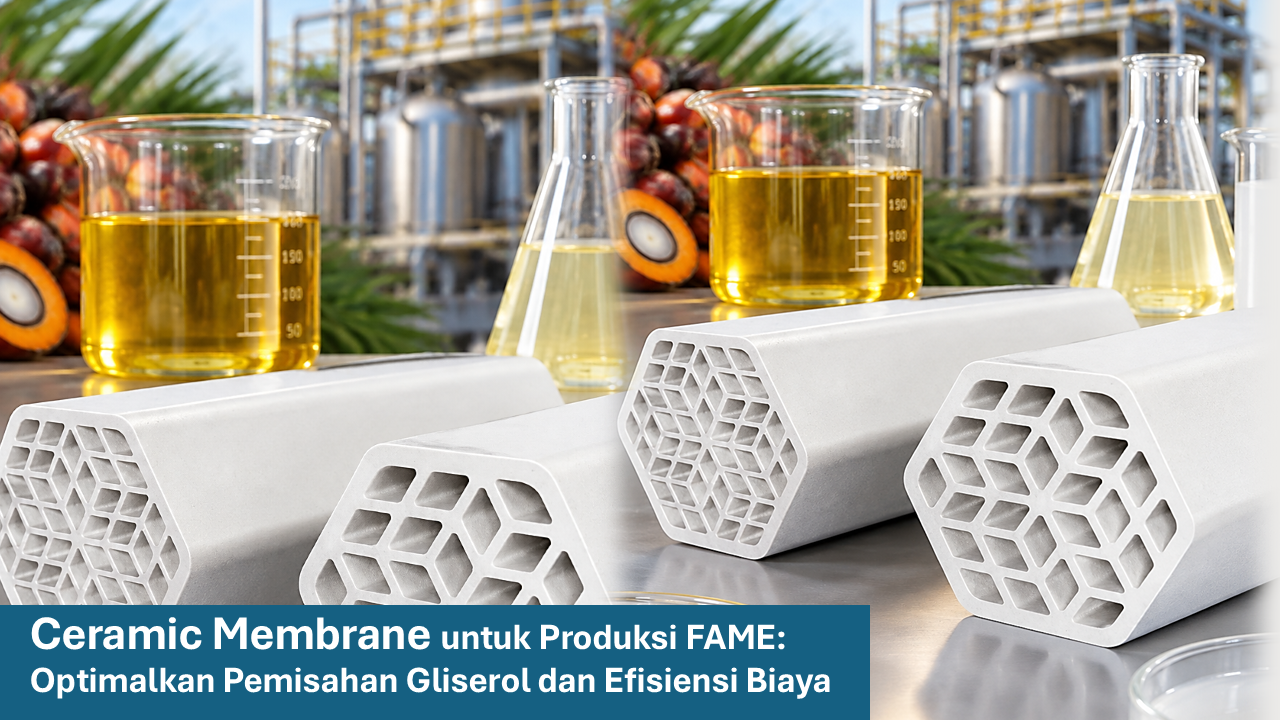
The biodiesel industry continuously strives to improve production efficiency while maintaining the quality of Fatty Acid Methyl Ester (FAME), the primary component of biodiesel. A significant challenge in this process is the separation of glycerol and the removal of residual contaminants following the transesterification reaction. If the purification process is not optimized, producers may face increased requirements for water, chemicals, and energy, as well as higher waste treatment costs. Consequently, ceramic membrane technology has emerged as a viable alternative for optimizing the separation and purification of biodiesel.
Ceramic membranes function based on their pore characteristics and specific operating conditions, which allow for the separation of particular components from a process stream. In the processing of FAME, this technology has been investigated for its ability to remove free glycerol, soaps, and certain contaminants from biodiesel. Research by Saleh, Dubé, and Tremblay, published in *Fuel Processing Technology* in 2011, demonstrated that an ultrafiltration ceramic membrane with a pore size of 0.05 µm could produce FAME with a free glycerol content meeting the standards used in the study—achieved after three hours of operation at 25 °C with a concentration factor exceeding 1.6. Another study by Wang et al., published in 2009, further highlighted the potential of ceramic membranes in biodiesel purification, noting their ability to reduce the need for water-based washing. These findings suggest that membrane technology can serve as an alternative or a complement to conventional purification processes, with performance contingent upon the characteristics of the raw materials and the specific process configuration.
From an economic perspective, the implementation of ceramic membranes can help producers optimize operational costs by reducing the demand for wash water, lowering the volume of wastewater, and simplifying certain stages of the purification process. Furthermore, ceramic membranes are recognized for their robust mechanical and chemical resistance, making them well-suited for a variety of industrial applications. Nevertheless, the extent of potential savings must be evaluated based on the actual conditions of the plant, including energy requirements, processing capacity, membrane flow rates, cleaning frequency, service life, and investment costs. It should also be noted that the separation of crude glycerol as a by-product is distinct from the removal of residual free glycerol from the FAME phase. These are separate processes that require appropriate separation configurations. With a proper process evaluation, ceramic membrane technology can serve as a viable option for enhancing FAME purification efficiency, maintaining consistent biodiesel quality, and supporting more resource-efficient and sustainable production.
Scientific References
1. Separation of glycerol from FAME using ceramic membranes
Jehad Saleh, Marc A. Dubé, and André Y. Tremblay (2011). Separation of glycerol from FAME using ceramic membranes. Fuel Processing Technology, 92(7), 1305–1310.
This study specifically addresses the use of microfiltration and ultrafiltration ceramic membranes to remove free glycerol from FAME.
2. Separation of biodiesel and glycerol using ceramic membranes
Research by several authors, published in the Journal of Membrane Science in 2010. Separation of biodiesel and glycerol using ceramic membranes. Journal of Membrane Science, 352(1–2), 271–276.
This study evaluates the influence of membrane pore size, operating pressure, and ethanol concentration on the performance of biodiesel and glycerol separation.
3. Refining of biodiesel using ceramic membranes
Yong Wang et al. (2009). Refining of biodiesel by ceramic membrane separation. Fuel Processing Technology, 90(3), 422–427.
This study evaluates the use of ceramic membranes to remove residual soap and free glycerol, with the aim of reducing water consumption during the biodiesel washing process.
4. Ceramic membrane technology for the separation of glycerol from biodiesel
Kakali Priyam Goswami and G. Pugazhenthi (2021). Effect of binder concentration on properties of low-cost fly ash-based tubular ceramic membrane and its application in separation of glycerol from biodiesel. Journal of Cleaner Production, 128679.
This research discusses the development of a fly ash-based ceramic membrane and its application in reducing the free glycerol content in biodiesel.

