In the modern world of electricity, the term "Power Quality" often comes up when discussing energy efficiency, system reliability, and electrical equipment performance. However, recently the term "Power Quality Spectrum" has also emerged, which sounds similar but has a different technical meaning. To avoid confusion, let's discuss the differences between the two in a simple yet in-depth way.
What is Power Quality?
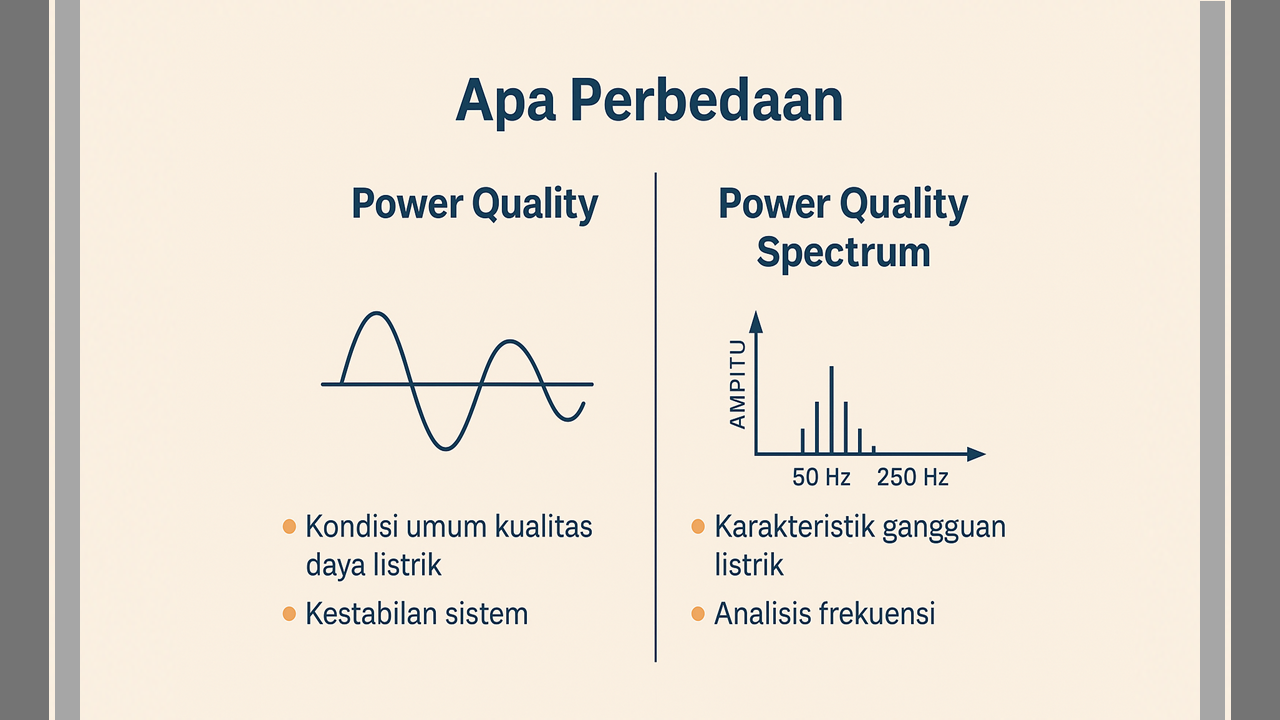
Power Quality is a measure of the "health" of the electricity supplied from a source (such as the state electricity company or a generator) to a load (electrical equipment).
The goal is to ensure that the received electricity is stable, efficient, and does not interfere with equipment performance.
Factors that affect Power Quality:
1. Harmonics – distortion of the current or voltage waveform from its ideal sinusoidal shape.
2. Voltage sag/swell – a momentary drop or increase in voltage.
3. Flicker – voltage fluctuations that can interfere with lighting.
4. Transient – ??a momentary voltage spike.
5. Unbalance – an imbalance between phases.
6. Frequency deviation – a small change from the standard frequency of 50 Hz.
7. Power factor – the ratio of active power to apparent power.
In other words, Power Quality measures the extent to which an electrical system operates according to ideal standards.
What is a Power Quality Spectrum?
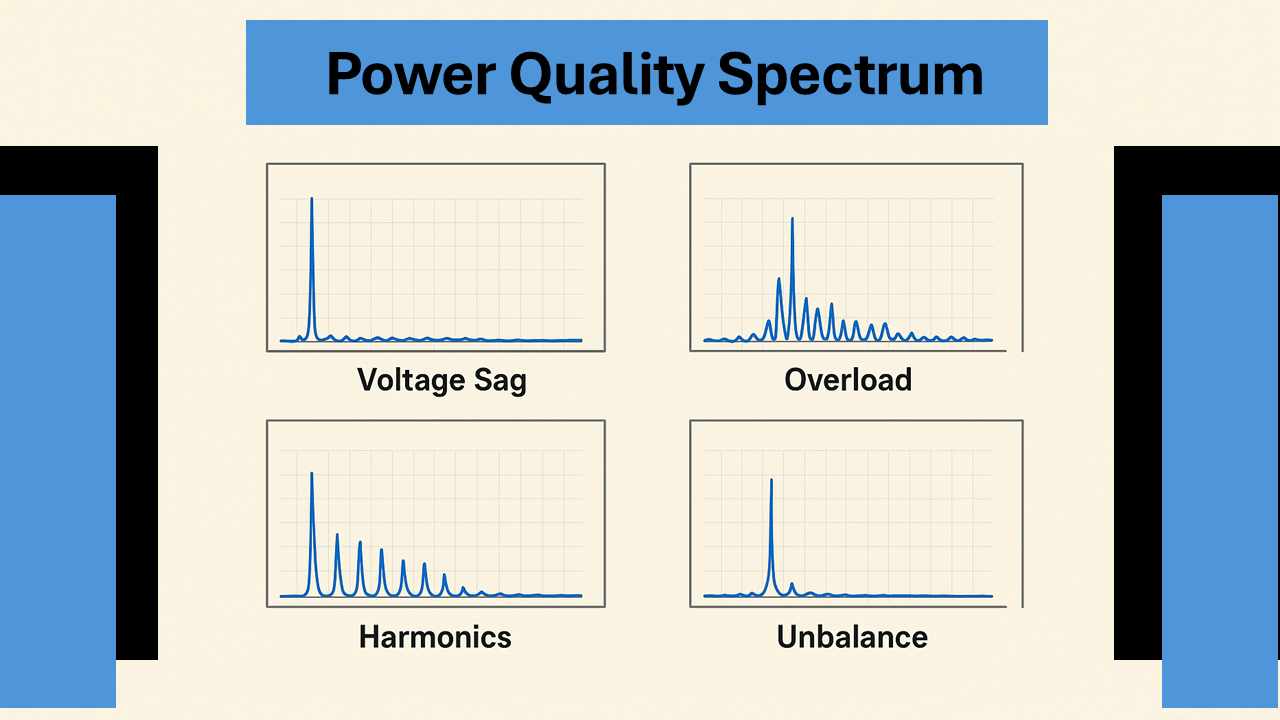
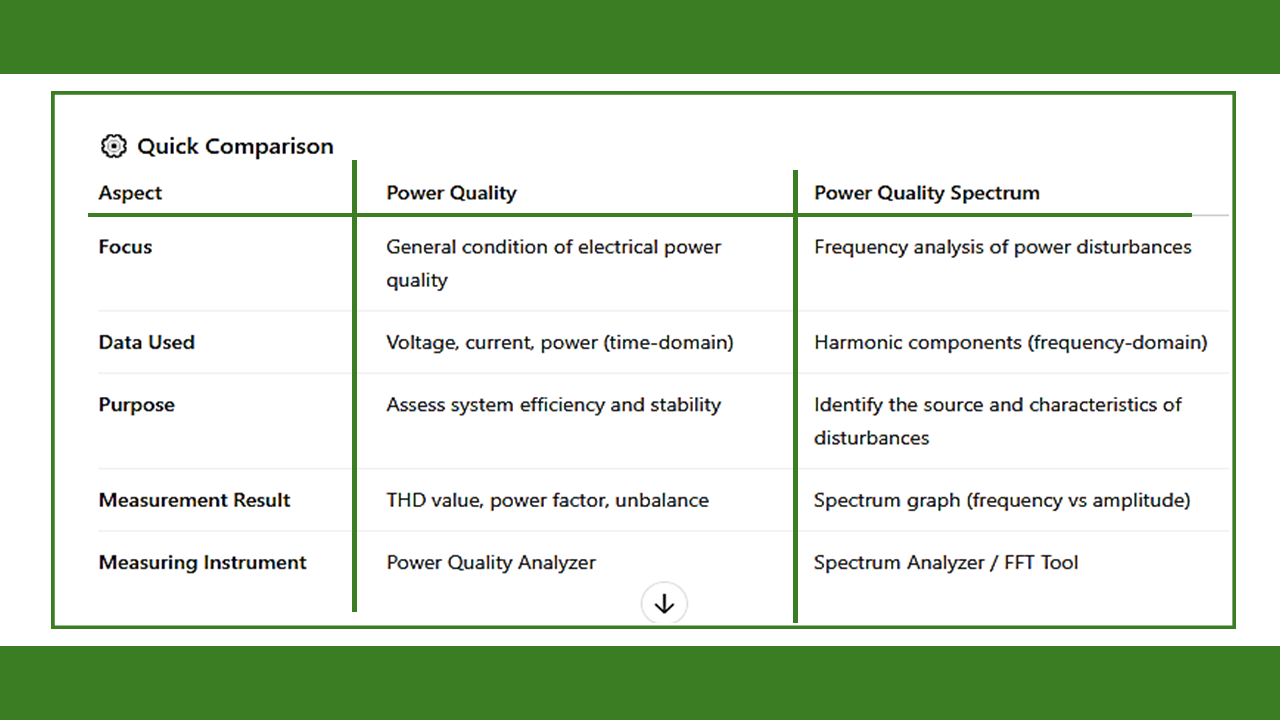
While Power Quality refers to the general condition of the electrical system, the Power Quality Spectrum is more specific: it shows the characteristics of electrical disturbances based on their frequency.
This analysis uses the FFT (Fast Fourier Transform) method to convert a time-domain signal into a frequency-domain signal.
The result is a spectrum graph—the X-axis indicates the frequency (Hz), while the Y-axis indicates the amplitude or magnitude of the disturbance.
Example:
- A healthy electric motor: only has a frequency peak at 50 Hz (main) and a few minor harmonics.
- A faulty electric motor: additional peaks appear at 150 Hz, 250 Hz, or 350 Hz, indicating significant harmonic disturbances.
By viewing the Power Quality Spectrum, technicians can identify the source and type of disturbance, for example, due to damaged motor bearings, load unbalance, or inverter distortion.
Brief Comparison
Conclusion
- Power Quality describes the general condition of the electrical system.
- Power Quality Spectrum describes why and where disturbances occur based on frequency analysis.