Behind every drop of biodiesel lies crucial information about its chemical composition that determines its efficiency, stability, and impact on engines. Therefore, a fast, accurate analysis method capable of "reading" molecular structures is needed — and this is where Fourier Transform Infrared Spectroscopy (FTIR) comes into play.
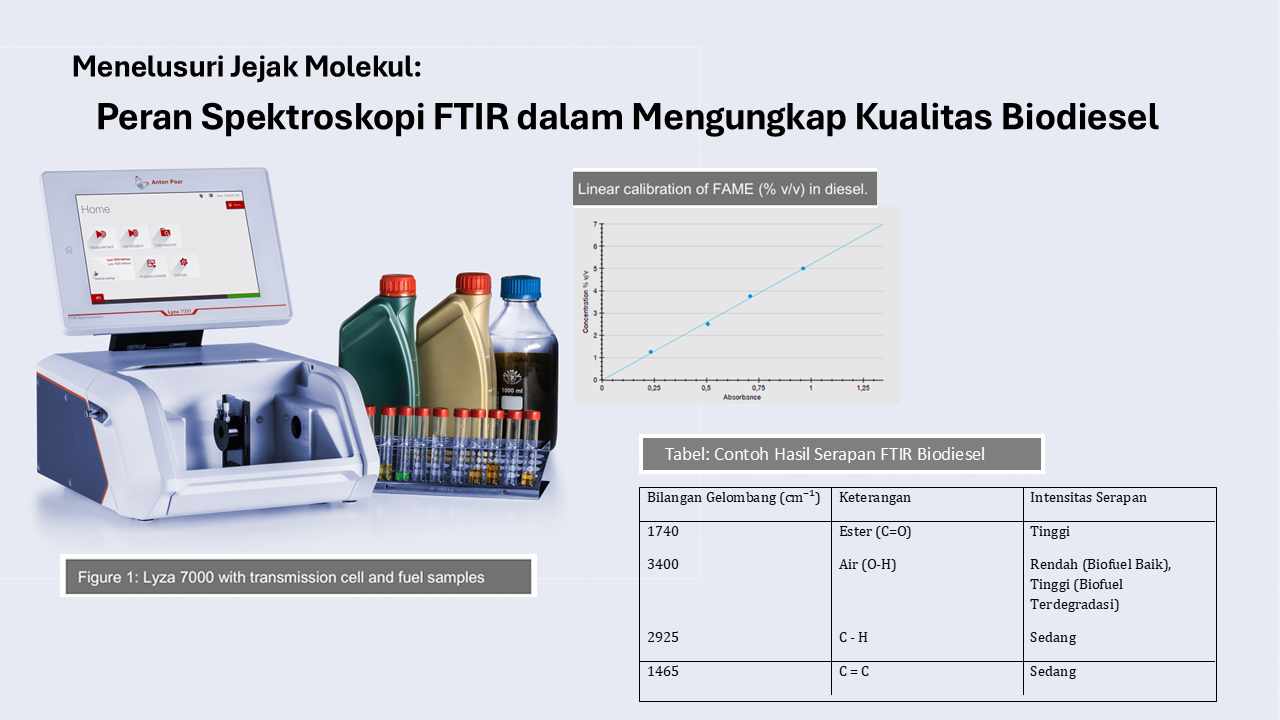
By utilizing advanced equipment from Anton Paar, FTIR testing becomes more precise and practical. This technology works by emitting infrared signals into a biodiesel sample, then analyzing the interaction of the light with the molecular bonds within it. The result? A "molecular fingerprint" in the form of a spectrum, which can reveal the presence of functional groups such as esters, alcohols, carbonyls, and hydrocarbons.
Why FTIR for Biodiesel ?
Biodiesel, have diverse chemical structures depending on the feedstock and production process. With FTIR, we can:
- Identify important functional groups (e.g., C=O of esters and free fatty acids)
- Detect contaminants such as water, residual alcohol, or glycerol
- Monitor oxidative degradation during storage
Advantages of the Anton Paar Instrument
Anton Paar's FTIR instruments are designed for the needs of modern industry:
- Fast: results in minutes
- No sample destruction: biodiesel remains usable after testing
- High reproducibility, suitable for routine quality control
Data Example: Quality vs. Degraded Biofuel
FTIR test results show that high-quality biofuel has a strong absorption peak at ~1740 cm?¹ (ester groups), and a low peak in the ~3400 cm?¹ region (indicating little water). Conversely, degraded biodiesel shows increased absorption in this region, indicating potential oxidative damage.
Conclusion
FTIR is more than just a laboratory tool—it is a window into the invisible world of molecules. In a biodiesel industry that continues to grow and move towards sustainable energy, Anton Paar's FTIR testing provides an edge in ensuring the quality, efficiency and reliability of future fuels.