
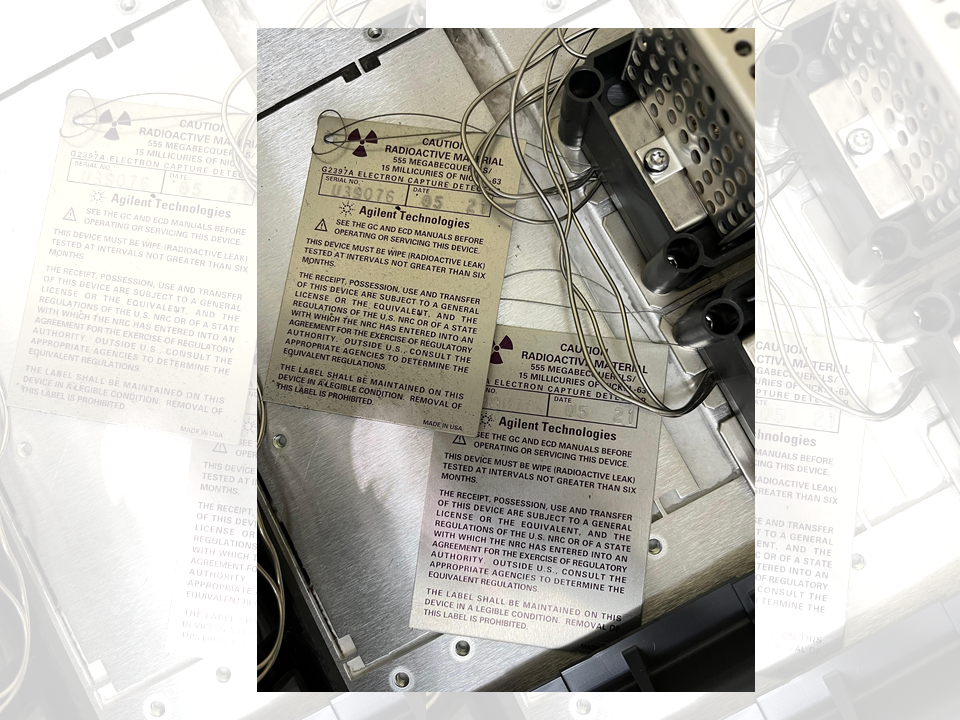
Gas Chromatography with Electron Capture Detector (GC-ECD) is a highly sensitive and specific analytical technique for detecting compounds that have a high affinity for electrons. ECD is particularly effective for detecting compounds containing halogens, peroxides, nitriles, or nitro groups. Some common applications of GC-ECD are:
1. Pesticides
• Organochlorines: Compounds such as DDT, dieldrin, and lindane.
• Halogen-Containing Organophosphates: Some halogen-containing organophosphate pesticides can also be detected.
2. Polychlorinated Biphenyls (PCBs)
• Detection and Quantification: ECD is highly sensitive to PCBs, which are important environmental contaminants to monitor.
3. Herbicides and Fungicides
• Chlorination: Many herbicides and fungicides contain chlorine atoms, such as atrazine and simazine.
4. Volatile Organic Compounds (VOCs) Containing Halogens
• Freons: Compounds such as freons and other refrigerant compounds.
• Brominated and Iodinated Compounds: Including some bromo and iodo compounds used in various industrial applications.
5. Nitro and Nitrile Compounds
• Nitroaromatics: Such as nitrobenzene and dinitrotoluene.
• Nitroaliphatics and Nitroalkanes: Such as nitromethane.
• Nitriles: Including acrylonitrile and related compounds.
6. Preservatives and Food Additives
• Halogen-Containing Compounds: Some preservatives and additives containing halogens can be detected.
7. Environmental Contaminants
• Perfluorinated Compounds: Such as perfluorooctanoic acid (PFOA) and other perfluorochemical compounds.
• Chlorofluorocarbons (CFCs): Compounds that play a role in ozone depletion.
GC-ECD Process
1. Sample Preparation: The sample is prepared according to a specific analytical method, which may involve extraction, purification, and derivatization.
2. Sample Injection: The sample is injected into the GC.
3. GC Column: An appropriate column is selected to separate the sample components based on volatility and polarity.
4. Detection by ECD: After separation, the components enter the ECD, which detects compounds based on their affinity for electrons.
5. Data Analysis: The results are interpreted using GC data analysis software to identify and quantify compounds based on retention time and detector response.
Advantages and Limitations of GC-ECD
• Advantages:
- High Sensitivity: Very sensitive to compounds containing halogens, nitros, and other high electron-affinity groups.
- Specificity: Very specific for certain compounds and allows detection at very low concentrations.
• Limitations:
- Not Sensitive to Hydrocarbons and Non-Halogen Compounds, namely Compounds that do not have a high affinity for electrons will not be detected properly.
- Detector Maintenance: ECD requires careful maintenance to ensure optimal instrument performance.
Conclusion
GC-ECD is a very useful tool for detecting and analyzing compounds that have a high affinity for electrons, especially those containing halogens, nitros, or other high electron-affinity groups. Its main applications include the analysis of pesticides, environmental pollutants, volatile organic compounds containing halogens, and some toxic chemical compounds.